Just days before the Oscar ceremony, Kaiony spoke with The Sentinel by Yuvoice.
When commenting on the Golden Globe awarded to The Secret Agent, acclaimed actress Fernanda Torres went beyond national pride and emphasized: “the Brazilian Northeast on the world stage. That’s what culture is for.”
1 – How do you view that statement? How do you understand the representation of the Northeast in The Secret Agent and in other productions set in or referencing the region?
KAIONY: Talking about the Northeast or showing the region in our productions shouldn’t be a reason for celebration — it should be natural, everyday. Unfortunately, due to recurring cases of prejudice against Northeastern Brazilians over the past decade, we are forced to assert ourselves so that our art is respected and recognized as part of our country’s cultural identity.
2 – Still on that subject, what is the importance of a Northeastern cast gaining international visibility?
KAIONY: In this case, I believe it’s extremely important to export Northeastern culture and art to show that Brazil is diverse, with multiple perspectives, formats, and expressions. Even within the Northeast itself, there is great diversity.
3 – You and Wagner Moura have emphasized that the central focus of The Secret Agent is memory — or even the absence of it. You were a child during that dark period of Brazil’s recent history. What do you remember, and how is that period represented in the film?
KAIONY: I was born in 1979. One of the most vivid memories from my childhood in the 1980s was when we were playing outside at night and would scare each other, saying that “the white hand” would come to grab, arrest, and make us disappear.
We didn’t realize that the “white hand” was actually a reference to the police forces that kidnapped and tortured people during Brazil’s military dictatorship (1964–1985). We were simply repeating what adults said.
“The white hand” was our version of the “Hairy Leg,” a legendary urban myth figure from Recife used to frighten children.
4 – How did you build your character from that era?
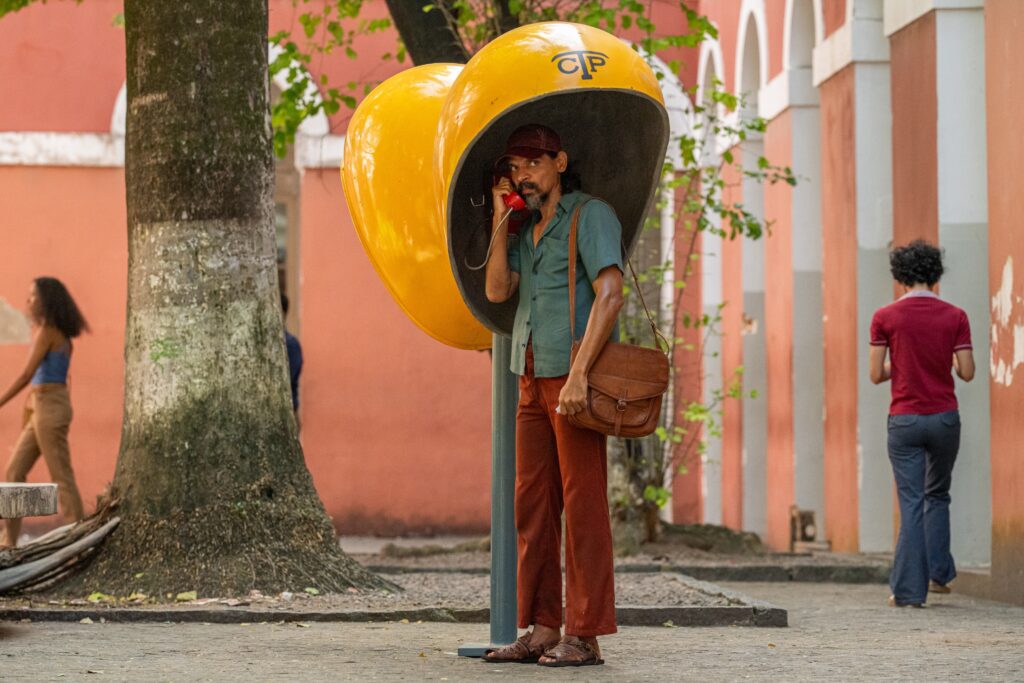
KAIONY: I had a real-life reference for the character “Vilmar” when I watched a 1970s documentary about the so-called “Gunman of Serra Talhada.” But beyond that, I built the character based on the precise guidance of director Kleber Mendonça Filho. He was meticulous in describing the character’s behavior, helping me reach the tone he envisioned.
5 – Although many deny it, the 1970s in Brazil were extremely violent, including violence carried out by the State. Your character portrays violence from another perspective—non-state violence. How do you relate these two forms of violence, which unfortunately still exist in Brazil today?
KAIONY: Vilmar is the product of social abandonment by the State. The fact that hired killers still exist today, especially in smaller cities, proves that you cannot separate street violence from state violence. The streets reflect sociocultural, structural, and above all educational neglect.
Vilmar holds a gun because he never had the opportunity to hold a book.
6 – Regarding that violence, how is that historical period perceived outside Brazil? What truth does the film carry beyond national borders?
KAIONY: For countries in South and Central America, it’s easier to relate to this theme, since many also experienced dictatorships—Argentina, Chile, and others across the continent. In Europe, countries that suffered through the two World Wars, the Cold War, and authoritarian regimes understand the context. But they are often shocked by the historical erasure of that bloody period in Brazil, which makes it necessary for us to keep revisiting such a difficult topic as the military dictatorship.
7 – Although Vilmar is a killer, you describe him as gentle or even sweet. Why?
KAIONY: Because he doesn’t kill like a serial killer. He didn’t choose that life; circumstances and lack of opportunity led him there. He doesn’t have a villain’s soul—he has a survivor’s spirit.
8 – With Brazilian cinema gaining international recognition for two consecutive years, what would you like to see improve? And concretely, what has already changed? What tangible impact has The Secret Agent had on Brazil’s film industry?
KAIONY: It’s not exactly The Secret Agent itself that is changing local production, but its achievements help society understand the importance of investing in national audiovisual production. Before we even began filming, the current government had already initiated the restoration of Brazil’s Ministry of Culture and resumed funding through cultural laws and public grants, injecting essential resources into our productions.
What needs to change is the mindset and strategy of our national film academy. It must see our films as works designed to compete in major international festivals, because that brings meaningful benefits to Brazil.
9 – You’ve said that your life can be divided into before and after The Secret Agent. What changed? And tell us about the audition where you forgot to attach your video and still got the role.
KAIONY: My life changed because of the tremendous impact the character achieved. It’s impossible not to be touched by his journey. Just today, I was crossing at a pedestrian lane when two men inside a car shouted, “Hey, Secret Agent!” Vilmar brought me immense and meaningful visibility.
The good part about the audition is that Gabriel Domingues, the casting producer, already knew me from the series Cangaço Novo, which helped because I had done strong work there.
As for the video test, I forgot to send an introductory clip about myself. Before filming began, I received an email from Gabriel’s team asking me to audition for Vilmar. I recorded the scene in my backyard, and nine days later I was called for an in-person audition with Kleber in Recife. I performed the scene three times on the street, he liked it very much, and told me: “We want the honor of working with you.”
10 – Since these questions were prepared before the four Oscar nominations, how do you feel about them? What are your hopes and predictions? And what about the Best Casting nomination — the new category that reflects the diversity of the film’s characters?
KAIONY: I’m really hoping we take home at least one award, even with strong competition. Best Casting would be fantastic, but if I could choose just one, I’d choose International Feature Film, because that award recognizes the entire team and the whole cast.


Comments
Be the first to share your thoughts!
We value diverse perspectives and respectful debate.