Awards in Berlin
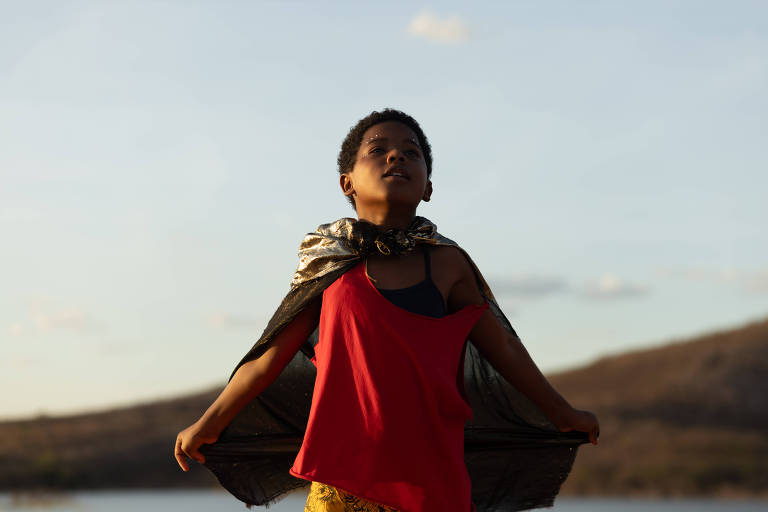
The Berlin International Film Festival (Berlinale) took place between February 12 and 22. The film was screened in the Generation Kplus section, a segment dedicated to works that explore narratives about growing up and coming of age for young audiences.
After its screening, “Gugu’s World” received a warm reception and took home two awards. The Grand Prix of the International Jury was granted by a jury dedicated to selecting the best feature film addressing the world of children and youth. The second award was the Crystal Bear, decided by a vote of the children’s jury.
“The audience applauded the film standing for eight minutes, and people came up to talk to us about how deeply the film touched them […] A man around 60 years old came up to me and said, ‘Look, I really saw myself in that boy, because I was a feminine child, a gay kid,’” André recounts.
Among viewers, the relationship between Gugu and Dilma was also warmly received. André Araújo described their relationship using the term “arenga,” a Brazilian expression from the state of Ceará that refers to a form of love expressed through playful bickering. “It’s their way of saying ‘I love you,’” André concluded.
Film critic Natália Bocanera attended the screening during the Berlin showcase and told The Sentinel about her experience:
“I believe the most striking point in Gugu’s World is the beautiful relationship built between grandmother and grandson and the freedom with which they express themselves. The idea of bringing together extremes carries with it the expectation of conflict and confrontation. However, Gugu and his grandmother Dilma never repel each other; instead, they complement one another to the point that together they radiate such a strong light that all we want is not to look away from their existence,” she concludes.
Natália also highlighted Lázaro Ramos’s performance, emphasizing how powerful it is to see him portray a role so different from his usual ones: that of a father who oppresses his son, struggles to connect with him, and yet still carries the complexity of loving him in some way, bringing the character closer to the reality of many Brazilian families.
The backlands and Alzheimer’s
During the interview, André Araújo also revealed the connection between the film’s narrative and the Brazilian sertão (the semi-arid backlands of northeastern Brazil), a setting that plays an important role in the story.
According to Araújo, the idea for the project emerged after encountering the former town of São Rafael, in the state of Rio Grande do Norte in northeastern Brazil, which is now submerged beneath a dam. The landscapes and the stories of local residents revealed that the impacts extend beyond the physical, reaching symbolic and subjective dimensions of people’s lives.
From this, André began to see the place as a space of memory. The city that is visible only when the water level of the dam drops became a metaphor for Alzheimer’s disease.
“You see a reservoir dry up and, little by little, the old city starts to emerge. Alzheimer’s is a similar process: as the disease progresses, something remains, and that something that remains is often very small. It’s no longer the memory, no longer the everyday recollections, but a trace of who that person once was.”
The relationship between Gugu and Dilma is directly affected by the disease’s progression, and a central part of the film is the coming-of-age that grows out of that experience.
“There comes a moment when he has to take care of his grandmother. He becomes adult-like. He switches roles with this woman: the one who should be caring for him becomes the one cared for by him.”
“Gugu’s World” currently has no scheduled release date in Brazilian theaters or on streaming platforms. International distribution has also not yet been confirmed.


Comments
Be the first to share your thoughts!
We value diverse perspectives and respectful debate.