Almir Silva, a Flamengo supporter for more than fifty years, told The Sentinel that the team’s international recognition marks a significant shift for its fanbase. “We have always been a massive group, and seeing the strength of our supporters extend to other countries and causes beyond football is remarkable.”
Campaign for recognition as a “Symbolic Cultural Nation”
The club’s participation in the “Football for the Goals” program comes amid a campaign led by Flamengo seeking symbolic recognition of its supporters as a “transnational cultural nation.” The concept refers to a group that shares culture, traditions, identity, and values, but is not limited by geographic territory or state sovereignty.
Such recognition has not previously been granted to a sports-related fanbase. If approved by relevant international bodies, the proposal would represent an unprecedented step, marking the first time a football fan community would receive this type of symbolic recognition.
In September 2025, Clube de Regatas do Flamengo launched an international initiative presenting a document to the United Nations advocating for the symbolic recognition of the so-called “Rubro-Negro Nation,” a reference to the club’s red-and-black colors. The proposal aims to highlight the sociocultural phenomenon represented by one of the largest sports communities in the world, with its own traditions, chants, history, and values.
The resolution would not aim to confer political status or territorial sovereignty, but rather to formally recognize the sociocultural phenomenon represented by Flamengo’s supporters. The club emphasizes that its fans are present not only throughout Brazil but also in several countries around the world.
“If we were a country, we would have the 36th largest population in the world. We are more than 45 million people united by the same flag, the same culture, and the same feeling that spans generations. Flamengo is not just a club—it is a nation,” said Zico during the 2025 campaign.
If accepted, the club argues that the resolution could set a precedent for other global communities formed around sports fanbases or cultural movements to be considered in international forums.
Global impact
The scale of Clube de Regatas do Flamengo’s fanbase helps explain why the club has drawn the attention of the United Nations for initiatives such as “Football for the Goals,” which seek to use sport as a tool for social mobilization.
In recent years, the club’s influence has expanded far beyond Rio de Janeiro, reaching audiences in other countries. International broadcasts and major sporting events have further increased Flamengo’s visibility.
One example is the club’s participation in the FIFA Club World Cup in 2025, which brought together teams from around the world, including Chelsea FC and FC Bayern Munich.
Founded in 1895, Clube de Regatas do Flamengo began as a rowing club before becoming one of the most prominent forces in South American football. Over the years, it has won national and international titles alongside legends such as Zico, Júnior, Romário, and more recently Gabriel Barbosa.
Today, it stands as one of the most successful clubs in South American football, having won three Copa Libertadores titles over its history.
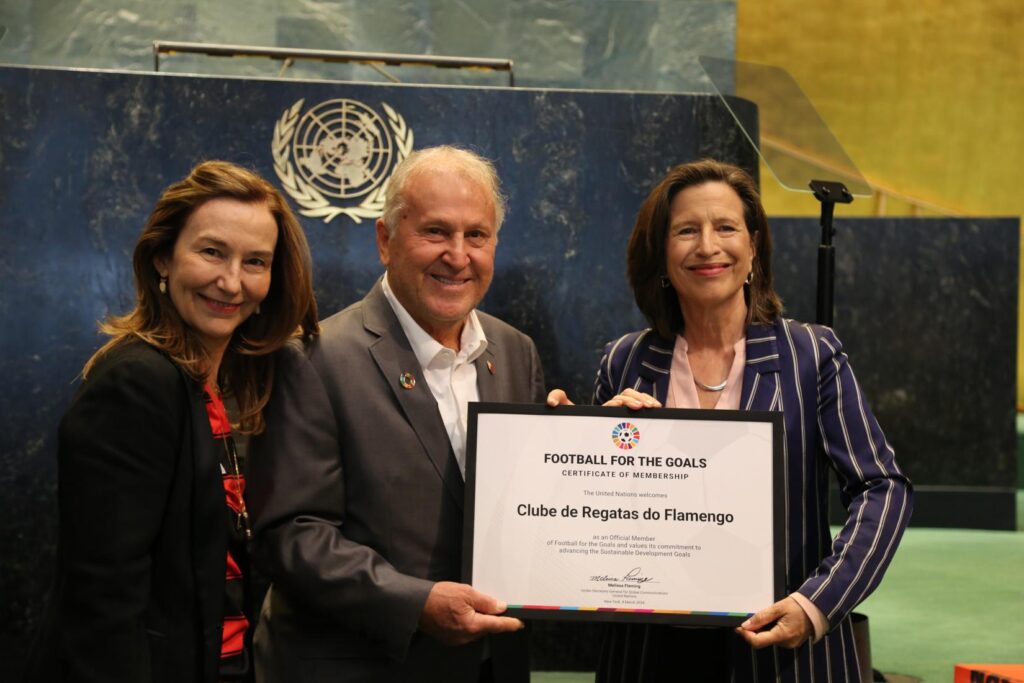
The club’s participation in the “Football for the Goals” program is expected to expand the reach of social initiatives linked to sport, generating positive impacts for communities in Brazil and around the world.

Comments
Be the first to share your thoughts!
We value diverse perspectives and respectful debate.