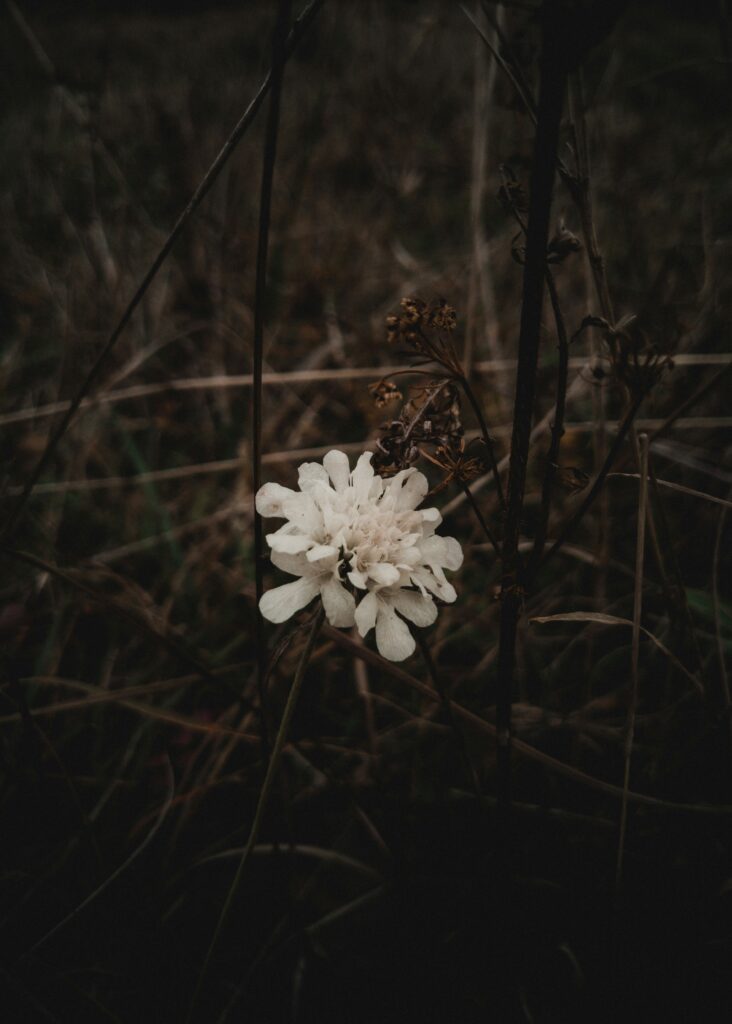
Flowering Go ahead and flower dear Let your colors shine So slowly the leaf unfurls Yet, so quickly you die.
But the joy is in the rising Inching upward in the sun Sipping from clear waters Till all your growth is done.
Glory in the flowering Because soon petals fall And no one will remember But you grew; you were tall!
Writing, like all art, is a dance between our conscious and unconscious minds — a tapestry woven out of what we know (about ourselves, our world, and eternity) and also out of what we do not. There is divinity in art, a magic both science and rational thought can’t quite account for.
All good and beautiful books write themselves, with only partial involvement from the author. I can see the man under the marble — only, the marble is my own mind. I must free him by writing, erasing, editing, throwing out, and starting anew, till the inside is liberated and visible to the outside: to the world, but also to myself.
For the last few years, my New Year’s resolution has been the same: Finish the book. I haven’t.
This year, my resolution is different: Make progress on the book.
Keep chipping away at the marble, breaking it down and piecing it back together, as many times as it takes. Live and let the book grow up around me, through me, in me.
To explain fully, I have to take you back to 2021, when I still believed in the usefulness of what turned out to be my two greatest enemies: plot and planning.
My senior year of college, I was revising, for credit, the first draft of a novel I had written during my senior year of high school (ie, I was reading it with a sense of horror and rewriting it). The idea for the novel had actually come to me many years before, in middle school, during a graveyard clean up. Elm Ridge Cemetery in Grass Valley, California: I was struck not just by the peacefulness of the place, but also by the weight of its history — all of those lives, spanning hundreds of years, reduced to a few, often illegible, verses carved into stone.
Subscribe to The Superhero Brief!
Free access to the CEO's newsletter.
The views expressed in this newsletter are those of the CEO and do not necessarily reflect the views of the organization.
I envied the people who lived next to the cemetery — their very backyard peppered with headstones. That is where I got my idea for my in-progress novel, Spinnerets. Spinnerets chronicles the childhood and adolescence of a little girl named Jean, who grows up right next to Elm Ridge Cemetery and spends most of her time playing with spiders.
But to return to 2021, I was trying to revise my first draft and making the exact same mistakes I had made in my first go-around at eighteen. Meticulously planning the book chapter by chapter (because isn’t that what you are supposed to do?), I brutalized my characters to stay on schedule, twisting their limbs into horrific contortions.
When I received full credit for my college course and reread my manuscript, I knew the second attempt was just as bad as the first. In an uncharacteristic moment of abandon — I am very vain and protective over everything I write and tend to save it, no matter how bad — I deleted the manuscript. I opened a new word document and wrote down the first words that came into my head. Those sentences and the scene that grew up around it became the opening vignette of Spinnerets.
I should note that I was undergoing a transformation at this time, which I owe to the little girl I was taking care of in the afternoons, one Sonali Holbrooke. (She will undoubtedly be a great novelist herself one day. Let it be known that I said it first).
We were sitting at the little table in her room, drawing pictures. I am awful at drawing. I am not lying to you when I say I cannot draw a tolerable stick figure, and I hate things I’m not good at. But on that day, I had a very simple thought that struck me as profound: Sonali and I weren’t drawing so we could produce a product others would find valuable. We were drawing for fun. The end result didn’t matter. The process did.
I thought back to the joy I experienced as a scribbling child, when I wrote for the love of writing itself, and the dread it engendered in me now. Writing hadn’t been about proving myself back then, didn’t have to be perfect. What if I could get that back, I thought. What if I could write like Sonali drew?
So I reached into my mind to recall the writing process of my childhood and found it to be aimless and spontaneous, having everything to do with daydreams and fantasy. I would picture characters, put them in a situation, and allow them to talk to one another, their conversations revealing who they were and what they meant to one another. With no plot or goal in sight, just a desire to let my imagination come to life, I let them speak for themselves.
What I started that day in 2021, I’ve held to. Spinnerets has no preconceived plot or direction. I have composed the bulk of it by sitting down at my great grandmother’s typewriter (which cannot backspace, an important part of my process) and writing whatever comes into my head.
And amazingly, vignette has built on vignette, fashioning plot where there was none, just as a plant grows up from the ground, very quietly and mysteriously. But every year, around New Years, I have held to the vestige of my former perfectionism — my need to control the narrative and produce something “worthwhile.”
“This year, I’ll finish it,” I’ve always said, over and over. I am only now realizing that, in light of my creative trajectory, such rigidity is ridiculous.
Spinnerets isn’t a structure I am building: it is a vine, growing from the soil inside of me, that I am tending. I cannot force its maturation any more than I can force the rain to fall.
In the years I have spent with my book, something beautiful has happened: we have inched upward and outward together, our existences helplessly intertwined and entangled. Did I see a water snake, swimming among the waters of the Yuba River? Yes, and Jean saw one, too — and that experience, grafted into the book, bloomed into a central motif, shaping both her life and mine.
I am writing Spinnerets as life is writing me.
So, this year, in 2026, I am vowing to let go of deadlines. My new resolution is this — I will continue on the path I set out on five years ago, but without hurrying myself, without time constraints. I will live, and I will write for the joy of it.
May my book sprout from that joy. I wait eagerly to see it flower.
Sofia Tietze loves the written word. She’s passionate about reading, writing, and editing the works of others. She received a bachelor’s degree in English (with an emphasis in creative writing) and a minor in professional writing from UC Davis and currently works by day as a medical editor. By night, she’s writing down her debut novel and whatever poem happens to possess her. On weekends, you can find her riding her pony in the Sierra Nevada or biking through Sacramento in search of new coffee shops and thrift stores.
Thank you to Michaela Brinker, Jessica Day and Josh Stanford for their inspired edits on the piece.



Comments
Be the first to share your thoughts!
We value diverse perspectives and respectful debate.