
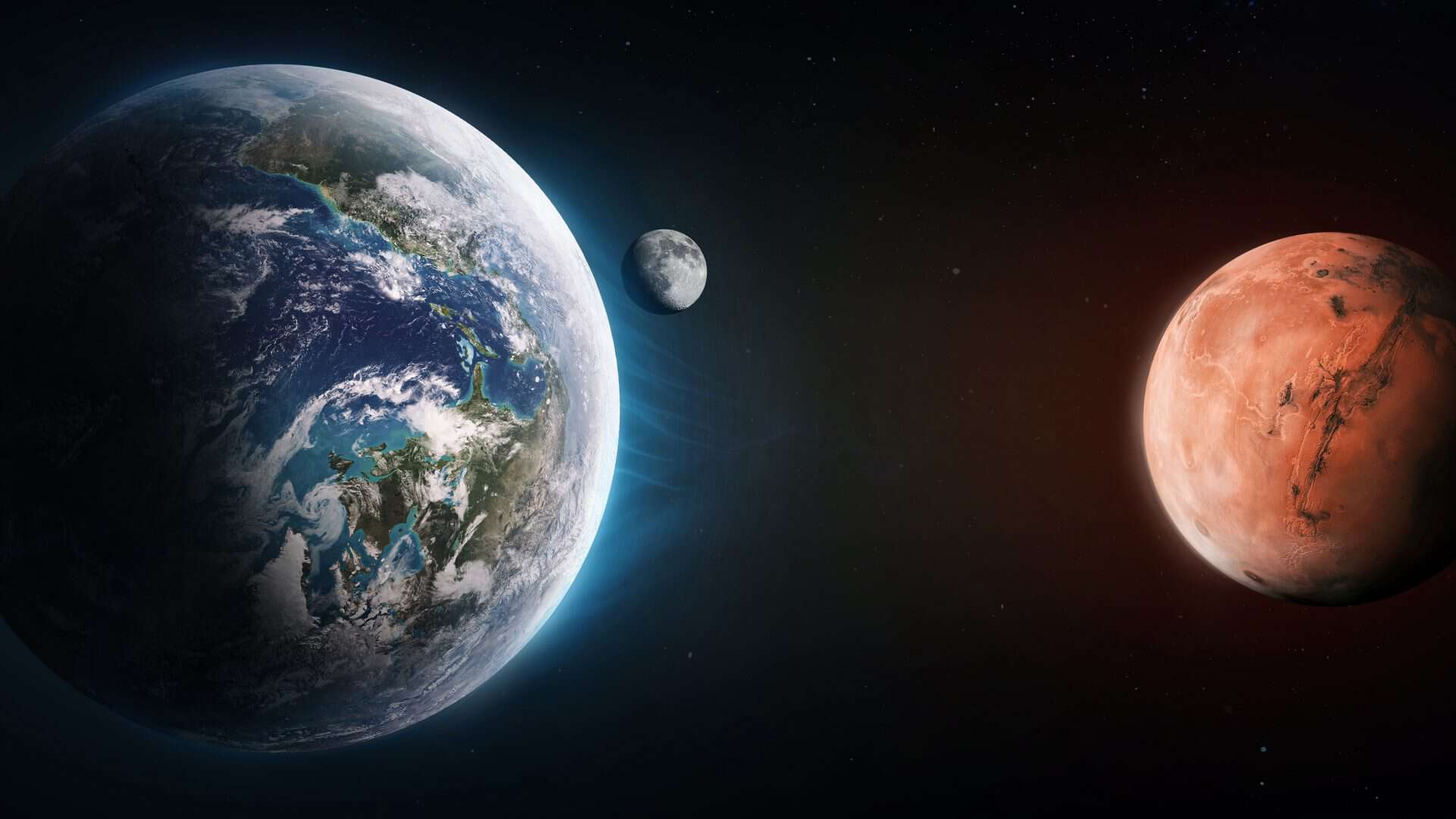
A Brazilian research project, initiated in 2015, used simulations and the trajectory of an asteroid as a reference to shorten the round-trip travel time between Earth and Mars. The study, published in the international scientific journal Acta Astronautica, proposes an alternative to conventional trajectories and rekindles debate over new possibilities for crewed missions to the Red Planet.
Scientist Marcelo de Oliveira Souza holds a degree in physics from the Federal Fluminense University, a public federal university in Brazil. He currently serves as a professor and researcher in the field at the State University of Northern Rio de Janeiro, a state university located in Rio de Janeiro state, in the city of Campos dos Goytacazes, southeastern Brazil.
He is the only astronomy specialist in a city of approximately 500,000 inhabitants. His study was recently published in the international scientific journal Acta Astronautica, which is associated with the renowned International Academy of Astronautics (IAA).
The journal is one of the most important in the field of astronautical science worldwide, publishing around 2,500 pages annually and covering discoveries and technological advances in the area.
“I started looking for asteroids that had some possibility, even a very small one, of passing close to Earth. Then I found the trajectory of an asteroid that had the possibility of passing near both Earth and Mars. So I thought, why can’t I use that trajectory as a reference to try to find a trajectory for a crewed trip to Mars?” Marcelo explained in an interview with The Sentinel by Yuvoice, describing how the study began.
The conventional route can take between two and three years in total, while the scientist’s proposal could reduce that duration to approximately seven months.
This would potentially allow a round-trip human mission to Mars projected for 2031, when the alignment between Mars, the Moon, and Earth—also known as the “Mars opposition”—would be more favorable for utilizing the route suggested by the researcher.
Technological advances over the past decade played a major role in Marcelo’s study, particularly the advent of Artificial Intelligence. He saw AI as a crucial partner in advancing his research, assisting with calculations, simulations, and new analyses of data he had already collected and previously examined.
Journey to Mars
Missions to the Red Planet are currently planned by NASA (National Aeronautics and Space Administration), ESA (European Space Agency), CNSA (China National Space Administration), and SpaceX (Space Exploration Technologies Corporation).
In Brazil, the Brazilian Space Agency (AEB) is responsible for implementing the country’s national space policy. Founded in 1994, the agency operates as the main public institution overseeing Brazil’s space activities and benefits from the country’s strategic geographic position in the Northeast, which is advantageous for satellite launches. Brazil has also developed capabilities in small satellite production and maintains global diplomatic and scientific partnerships.
Despite the shortened route, the scientist emphasizes that the major innovation lies in the method used to reach this result. Using a celestial reference—in this case, asteroid 2001 CA21—is what makes Marcelo’s study a potentially significant scientific milestone for Brazil and the world, especially as private companies have intensified plans to send humans to Mars.
Beyond the simulation results, Marcelo says the international attention surrounding his discovery has been gratifying and sees it as fundamental for inspiring other researchers and future scientists to pursue studies in this field within Brazil, potentially positioning the country as a reference in astronomical science.
His research was not only published in Acta Astronautica, linked to the International Academy of Astronautics, but also gained visibility on ScienceDirect, a major U.S.-based scientific literature platform with global reach. According to the researcher, the study has already been reported in approximately 50 countries, including Argentina, Spain, and India.
“I hope that this visibility at least helps motivate young people and children to pursue careers in this area, which Brazil needs. We often use NASA as a reference, and NASA is associated with space exploration, so people are naturally interested in that. What I feel is missing, for example, is for the Brazilian space agency to occupy that space within Brazil. I hope that with this work and others that will emerge, we can open a path for a national trajectory in this field,” Marcelo said regarding his expectations for the study and its impact.