Mega Police Operation in Rio Raises Concerns Over Public Safety
By Ana Lívia Vale
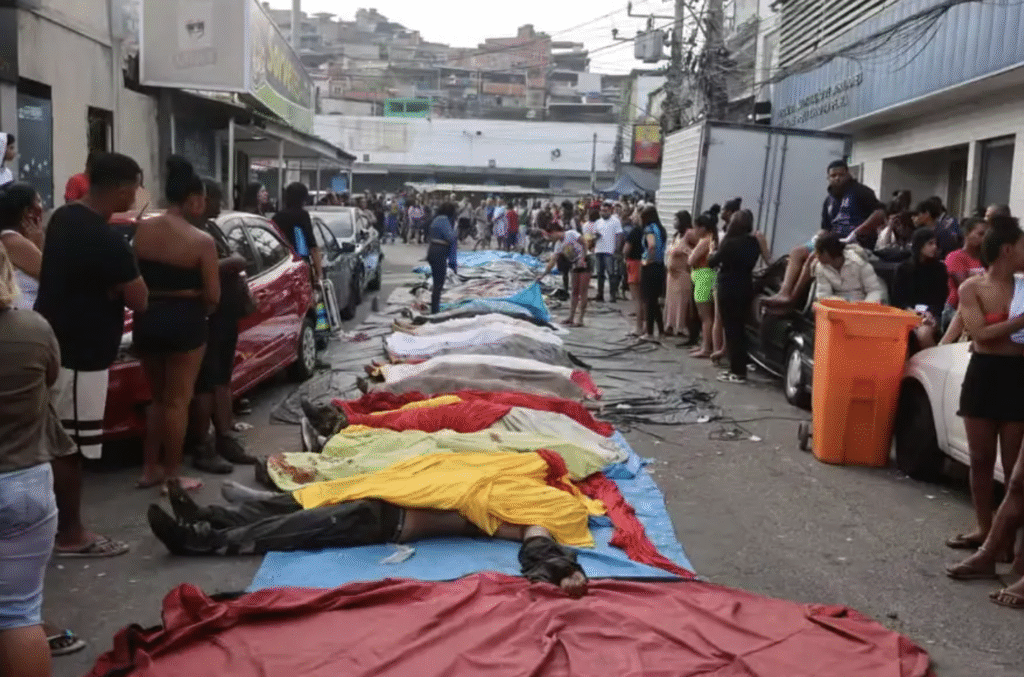
Bodies Are Lined Up On The Ground And Observed By Residents In The Penha Complex (Photo: Fabiano Rocha)
Trigger Warning:violence, death, and disturbing imagery
On October 28, 2025, the city of Rio de Janeiro, Brazil, was the scene of the deadliest police operation in the state’s history. The state government reported the deaths of 117 civilians, classified as “neutralized opponents,” and four police officers.
According to the state government, the objective of the operation was to apprehend members and leaders of the criminal faction known as Comando Vermelho (CV), associated with drug trafficking not only in the state of Rio de Janeiro but also in other states across the country.
The so-called “Operation Containment” took place in the Alemão and Penha complex of favelas, located in the North Zone of the city of Rio de Janeiro, and mobilized around 2,500 military and civil police officers, with the use of helicopters, armored vehicles, and support from special units. The operation reportedly lasted about 15 hours.
The final outcome of the action resulted in the arrest of 99 people—17 through the execution of court warrants and 82 caught in the act. Authorities also seized 122 weapons, including 96 assault rifles, 25 pistols, and one revolver, in addition to explosives and large-caliber ammunition.
In a public statement released by Amnesty International Brazil, dozens of human rights organizations in Brazil questioned the proportionality of the operation given the level of lethality recorded.
“There are no elements [in the operation] that effectively reduce the power of criminal factions in the territories. On the contrary, these actions deepen insecurity and fear, instill panic, disrupt the daily lives of thousands of families, prevent children from going to school, and impose terror as an expression of state power. Death cannot be treated as public policy.”
Subscribe to The Superhero Brief!
Free access to the CEO's newsletter.
The views expressed in this newsletter are those of the CEO and do not necessarily reflect the views of the organization.
Impacts on the Community
The operation began at 6 a.m. on Tuesday, without prior evacuation warnings, and affected around 26 communities within the Alemão and Penha complexes. On the same day, the city entered level 2 of the risk system adopted by the Rio de Janeiro City Hall, requiring constant monitoring by the Civil Defense.
The city was immediately affected, most intensely in the areas where the operation unfolded. According to residents, the atmosphere resembled urban warfare, with intense gunfire, barricades, and widespread panic. Several public services were suspended, including schools and public transportation.
The administrator of the page “Pega Visão RJ,” who chose not to disclose his name, spoke exclusively to The Sentinel about his experience as a resident of the Penha complex and as the manager of a website that shares information about police operations in Rio de Janeiro’s favelas.
“Because I live here and didn’t go to work that day, for obvious reasons, I focused on passing information to residents and everyone else through social media,” he said. “There were many gunshots, arrests, police movements, deaths… People who live here are always afraid to go out on the street, apprehensive, and scared of stray bullets.”
He also admitted that he does not notice any reduction in crime levels after police raids like this. “Nothing changes; the police leave and everything goes back to normal.”
After the armed confrontation on the 28th, the removal of bodies was largely carried out by residents. Young people and even children took part in searching for and removing the bodies.
This occurred due to one of the strategies adopted by the Special Police Operations Battalion (BOPE), which involved entering through a forested area connecting the Alemão and Penha complexes, known as Serra da Misericórdia. This region had been identified by police as an escape route for criminals.
This area, known as the “BOPE wall,” was where most of the victims were later found. However, the military forces did not request the isolation of the site for forensic investigation, forcing residents to witness the violent scene in order to collect the bodies.
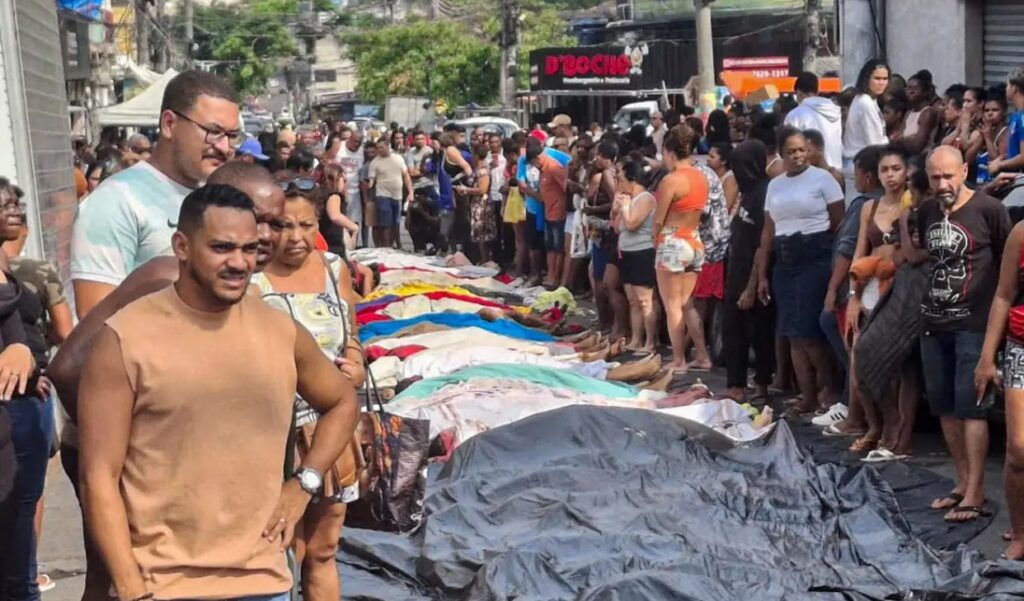
BODIES LINED UP AFTER THE POLICE OPERATION IN RIO DE JANEIRO. (PHOTO: EUSÉBIO GOMES)
After more than 50 bodies were removed, residents transported them to “Praça São Lucas,” in the Penha Complex, where they were lined up so that family members and friends could identify them. During this process, the victims’ clothing was removed, leaving only underwear. Residents said the measure was taken to facilitate identification, including through tattoos.
The police strongly criticized the removal of the clothing, claiming that most of the bodies were wearing camouflage clothing, vests, and operational boots associated with combat, and that some were carrying ammunition, drugs, and cell phones in their pockets.
However, this narrative cannot be verified due to the absence of an official request for the collection of the bodies. This also compromised the possibility of a more detailed forensic analysis of the circumstances under which the deaths occurred at that location, which was isolated from other areas.
Following the removal of the bodies from the forest, reports and complaints regarding the high lethality of the operation increased. In the days that followed, residents and relatives of the victims took to the streets to protest, defending the right to due process without execution, in a country where there is no death penalty.
One of the most emblematic cases was that of 19-year-old Yago Ravel Rodrigues. The young man was found in the forest with his head hanging from a tree and was identified by his parents at the Legal Medical Institute (IML), with his body separated from his head.
In an interview with the newspaper Estadão, a family member who preferred not to be identified said: “We are not outraged because Ravel died—of course it hurts. We are outraged by the way it happened. If it were a shootout, we would understand; it’s a confrontation. Ravel was decapitated and placed in a tree. He was put there like a trophy.”
The family claims that the young man had joined the Comando Vermelho street gang about two months earlier, drawn by the financial promises offered by criminal factions to poor youth. “Ravel was dazzled by a life that people from the outskirts see. We’re not used to seeing lawyers or architects. We’re used to seeing ostentation,” the family member reported.
The governor of Rio de Janeiro, Cláudio Castro, said he considers it impossible that the decapitation was carried out by police officers involved in the operation and stated that the Civil Police are investigating the episode. “No one believes that a police officer cut off the bandit’s head. I believe the criminals themselves decapitated him to shift the blame onto the State,” he declared.


Comments
Be the first to share your thoughts!
We value diverse perspectives and respectful debate.