These cases are just a few among many that happen every day in Brazil. Although legislation provides for the punishment of men who kill women simply because they are women, aggressors remain undeterred. Not even protective measures—such as court-ordered minimum distance from the victims or monitoring with electronic ankle bracelets—intimidate some attackers.
In Brazil, many women suffer violence every day simply because they are women. Since 2015, Brazil has recognized this type of murder as “femicide,” a heinous crime. The report Elas Vivem, by the Network of Security Observatories, estimates that every 15 hours a woman is murdered in Brazil. Sixty-eight percent of these murders occur inside the victim’s own home, and in 70 percent of cases the perpetrator is a current or former partner. Some statistics point to a 26 percent increase in reports of violent incidents against women in 2025 compared to the same period in 2024. In the first half of 2025 alone, 683 children were left without their mothers due to violence, according to data compiled by the Laboratory for the Study of Femicide (Lesfem) at the State University of Londrina. The laboratory projects 950 femicide victims by December 2025. In the second half of December, the Federal Government promoted a meeting between the Executive and Judiciary branches to outline a strategic pact with measures addressing violence against women.
The increase in violence rates recorded in the country has drawn the attention of scholars. In an interview in early December 2025 with Folha de São Paulo, demographer Jackeline Romio stated:
“We are experiencing an epidemic of gender-based violence—whether femicide, sexual violence, homicide (the violent death of women), or suicide, which has also been increasing. All these types of violence against women have already reached levels that must be monitored. In Brazil, we have surveillance data on cases resulting from violence. We can say that gender violence, in its various forms, has already reached, since 2010, levels that should be monitored as epidemics. They go beyond any expectations we previously had. Regarding femicide, it only increases and will continue to increase.”
One concrete measure, which does not repair the violence but strengthens a support network for victims, was recently evaluated by the Supreme Federal Court: granting financial assistance in the form of paid work leave to women who are victims of violence, similar to what already exists for Brazilian workers who face illness. Employers will be responsible for the costs of these leaves during the first 15 days away from work, and the INSS—the federal agency responsible for worker and retirement benefits—will assume payment after this initial period. In this way, victims can take care of their health while maintaining their income. It is worth noting that, in many cases, these women even require prolonged hospital stays due to the severity of the violence.
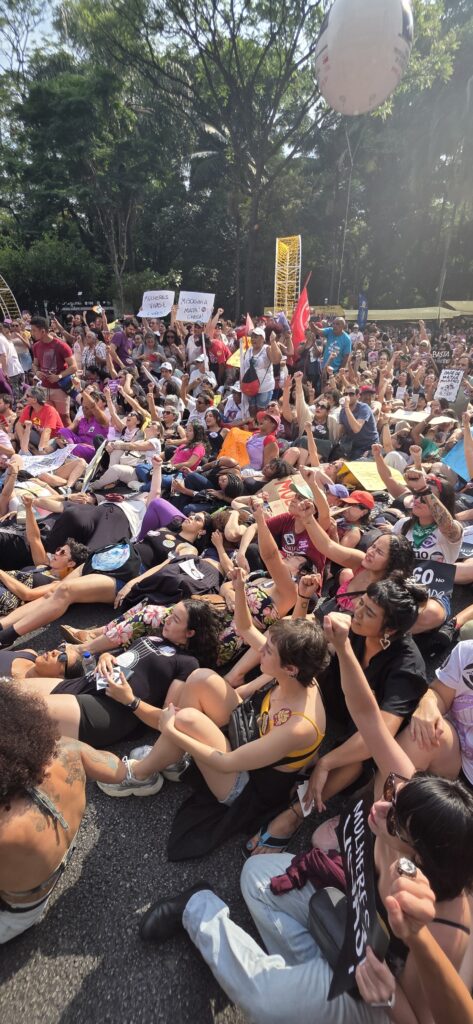
In several cities across the country, protests against this “epidemic” of violence took place in the first days of December.
Rachel Ripani is a Brazilian actress, director, and feminist activist. She participates in lectures, podcasts, and social media content production, emphasizing the importance of feminism. Rachel spoke with The Sentinel about the epidemic of violence against women in Brazil in late 2025:
The year 2025 is not even over yet, but statistics point to an increase in violence against women compared to 2024. What do you attribute this rise to?
Experts say that the fact that assaults are now being recorded—on cell phones in public spaces or on internal security cameras, such as in elevators—may give this perception. We are also seeing a slow education of police forces to recognize femicide and gender-based violence, which increases reporting. But I believe violence is objectively increasing due to hate speech and anti-women’s rights discourse that is fostered and monetized digitally. The manosphere, incels, and red pills spread hatred and lies against women without any punishment. On the contrary—violent words become violent actions. This is obvious to us. But for the Senate and Congress, it seems the saying applies: those who hit forget, but those who are hit do not.
In the last weekend of November 2025, we witnessed episodes of violence against women that seemed to surpass the usual level of cruelty. In your experience, do men feel freer to commit even more cruel acts? What is your opinion on impunity or the lack of effective punishment for such serious crimes?
Violence against women is, in practice, authorized. If 98 percent of rapists never spend a single day in prison, how can we curb violence? If the prevailing culture doubts women who report abuse, if neighbors “don’t get involved,” if children have no sex education in schools, how will they know that what they experience is abuse? Punishment alone is not the solution, although I do support severe penalties. We also need education and a change in mindset.
What kind of discourse do repeat offenders use to keep their partners close, even after previous episodes of violence?
It’s the so-called cycle of violence. At first, the man is a prince; he puts you completely on a pedestal. Slowly, very slowly, he distances you from people who would warn you about the control he begins to exert over you. Then comes gaslighting. If an abusive relationship began with a punch, no woman would stay. But that’s not how it works. It’s like a staircase—you go down one step at a time. And when you realize it, you’re at the bottom of the pit.
Beyond the law that already exists, what other measures would you point to as medium-term solutions to violence against women? Is Brazil a sexist country? How can we correct this historical acceptance or leniency toward partners who beat their own companions inside their homes? Remembering that 70 percent of violence cases in Brazil occur inside the home and are perpetrated by the partner.
The first is the criminalization of misogyny, a bill that is stalled in the Senate. We have several other legislative proposals that we want to present to leaders of the executive and judiciary branches, listed in our policy framework document available on our profile, @levantemulheresvivas.
How do you reconcile what you call conciliatory feminism with the urgency faced by women suffering violence today? Is this conciliation a long-term solution? Until then, what would be your proposal to prevent cruel deaths like the one in the horrific case of Tainara, who was dragged for more than a kilometer attached to her ex-boyfriend’s car? This case recalls the level of cruelty of former basketball player Igor Eduardo Pereira Cabral, who assaulted his girlfriend Juliana Soares in an elevator in July 2025 in Rio Grande do Norte, punching her 60 times in the face, all recorded by security cameras. Juliana had to undergo facial reconstruction surgery.
Obviously, in such cases, conciliation is impossible. Against crimes, I advocate severe punishment. Conciliation lies in feminism no longer being seen as a dirty word, no longer being perceived as a movement against men. This imaginary gender war does not exist. Women do not hate men. But men need to understand and position themselves as allies of women. That is conciliation. It comes from a space of dialogue and care, not from exclusionary dogmatic certainties.
We know behavioral change comes through education. What suggestions would you give so that, in a few years, more men consider the idea of hitting a woman absurd? After all, hitting any human being is absurd, since we are rational animals living in an organized society governed by law.
The Maria da Penha Law already provides for educational actions, as is the case in England, which adopted them after the series Adolescence. Educational initiatives in schools would be a great start. For adults, men should begin speaking up in their groups when a colleague posts a joke that demeans a woman or shares nude images without consent. When men consider rape as unacceptable as cannibalism, we will be closer to safety.
What explains a certain normalization of violence by people who do not live close to cases of aggression against women? How can these people be sensitized to become active agents in spreading ideas against violence?
It is very hard to grasp the magnitude of the gender disparity we live with. It is painful for women and can foster a sense of guilt in men—and guilt is paralyzing. That is why I believe that bringing men into the debate allows for positive, not imposing, action with our partners. Awareness can happen in a sensitive way, not sensationalist or imperative. As a woman, at a certain point in my life, I could no longer ignore the cumulative violence I had experienced, and that motivated me to begin my activism. Each person has their own path.


Comments
Be the first to share your thoughts!
We value diverse perspectives and respectful debate.