From 1900s to 2026: What’s changed?
Non-Cooperation (1920–22) → Civil Disobedience & Salt March (1930–34)→ Quit India (1942) → Radio & Print (1940s–80s) → Television (1980s–2000s)→ Internet & Hashtags (2000s–10s) → Smartphones & Social Media (2010s–Present) → Streets + Screens (Today)
The methods have evolved, but the voice of dissent continues to seek an audience. Television added a new dimension. Now, protests happening in Delhi or Mumbai could easily be broadcast to different regions, changing the relationship between protest and visibility. In the recent unfolding, though the main protest was ongoing in Delhi, their images, videos, and messages circulated widely, gaining support from Tier-II and Tier-III cities also. In regional hubs like Patna, Jaipur, Ranchi and Lucknow, parallel solidarity emerged.
The latest exam-integrity mobilizations showed the utilisation of media tools to create operational networks. WhatsApp broadcast channels, Telegram groups, and Instagram communities were set up to disseminate real-time legal advisories and organize emergency volunteer medical teams. One major highlight was the compassionate individuals throughout India and abroad transforming food delivery platforms like Zomato and Swiggy into tools of peaceful support. Anonymous donors consistently sent meals, tea, bottled water, and vital health supplies straight to the protest locations. Digital infrastructure made this decentralised support possible.
How the Movement travels
Contemporary mobilization has used digital infrastructure efficiently. The boundaries between protestors, journalists and commentators are increasingly blurred. In the recent Jantar Mantar student rallies, raw video footage was recorded on mobile phones by the participants, rapidly edited, annotated with information on exam leak timelines, translated into local languages and distributed across social media, acting as primary reporters, curators and news anchors of their own movement. Therefore, besides the street, a second life of protest could be easily found online.
Social media has also transformed how the protests are organized. A simple hashtag can allow scattered individuals to identify themselves with a common cause. This was witnessed in the recent demonstrations with the use of hashtags like #NEETpaperleak, #GenZProtest, etc., bringing isolated, frustrated students across Bihar, Uttar Pradesh, Rajasthan, and all other states into a unified national collective. Aspirants who never met each other in person started mapping their struggles together onto a national platform. Messaging facilitates coordination throughout. Short video content makes information more convenient to share and absorb. Livestreaming helps people outside the movement to associate themselves simultaneously.
Internationally, various movements through digital platforms have been able to link individual experiences with a collective campaign. By May 2018, the #BlackLivesMatter hashtag had been used around 30 million times on Twitter, according to the Pew Research Center, demonstrating the scope of digitally mediated political expression. Additionally, more recent Pew data demonstrates how commonplace internet civic engagement has become. According to a 2023 poll, 46% of American social media users reported engaging in at least one type of online issue-based political activity, such as joining groups that support causes, promoting action, looking up information on protests, altering their profile images, or using political hashtags.
Where do the protestors go from here?
Some of the challenges associated with the digital aspect require attention. What is visible depends on the algorithm of the social media platform. Influencers, virality, news cycles, and the emotional appeal of particular images serve as other influencing factors too. This creates a contradiction. While digital media have made it easier for anyone to express themselves, it hasn’t ensured equal access to attention.
The Freedom on the Net 2025 report by Freedom House classifies India as “Partly Free” with an internet freedom score of 51 out of 100. The report highlights that during the protests in November 2024, authorities enforced an internet blackout in Manipur, while also recording extensive constraints on online political discourse. This illustrates that the internet is neither a free space nor an entirely unrestricted space. Undeniably, the geography of protest has expanded, but so has the mechanism through which it can be controlled. As governments enhance their strategies for physical control and digital oversight, the persistence of democratic accountability will rely on citizens’ ability to maneuver through both realms, utilizing screens to reveal the truth and streets to call for genuine transformation.
The ongoing significance of physical space is highlighted in initiatives that blend digital organization with focused use of public areas. Unconventional, hyper-local protest methods have emerged in recent years. The Shaheen Bagh sit-in in 2019–2020 turned a Southeast Delhi suburban thoroughfare into an ongoing public gathering spearheaded by women. In a similar vein, hundreds of thousands of young people participated in the 2017 Jallikattu protests along Chennai’s Marina Beach without the use of official political party structures. They relied only on peer-to-peer social media networks to organize sanitation, medical treatment, and logistical support.
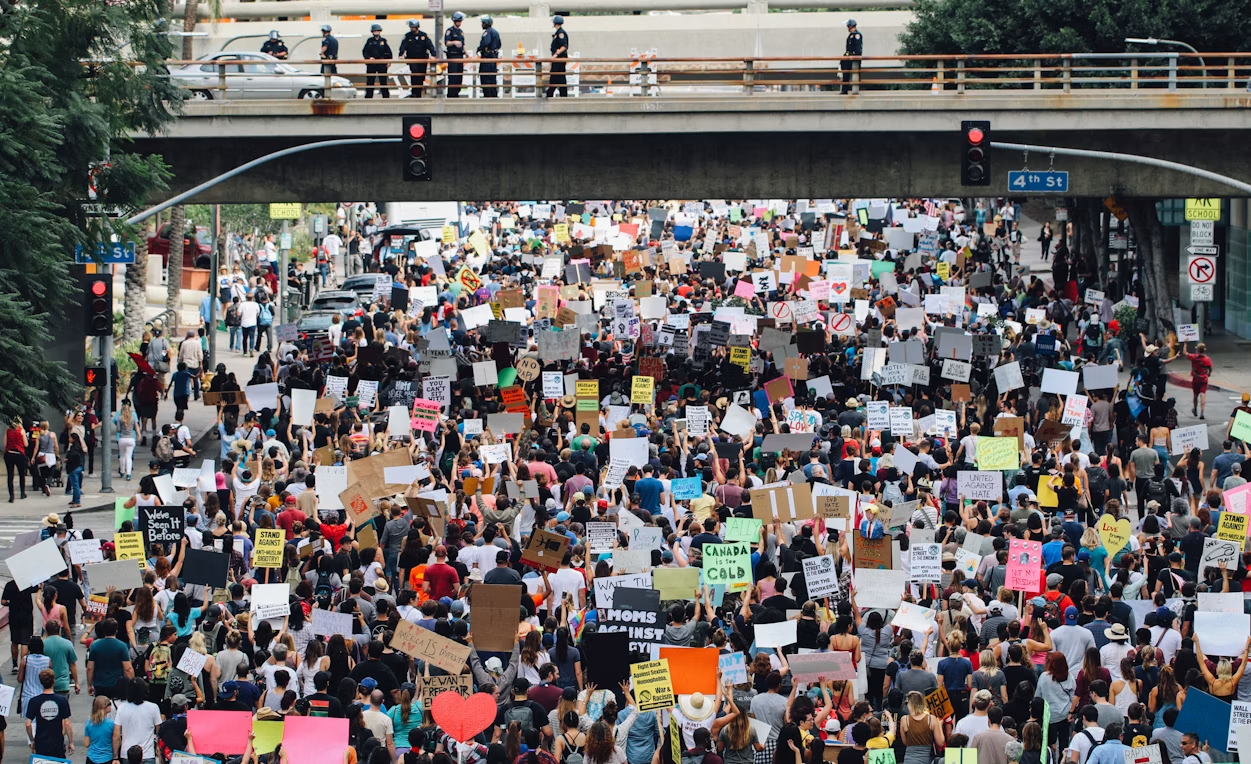
These changes depict a wider shift in the manner dissent occupies space. Public demonstrations continue to be disruptive because they interfere with daily life routines, while their digital extension allows that disruption to extend well beyond the original location. The issue, then, is not if public space is still essential, but rather how much space a democracy is ready to provide for dissent. The future of protest doesn’t lie in streets or screens; it belongs to the space between them. The demonstration has not vacated the street. It has merely figured out how to navigate.


Comments
Be the first to share your thoughts!
We value diverse perspectives and respectful debate.