Brazil’s landmark sustainability festival paves the way for COP30
By Ana Lívia Vale
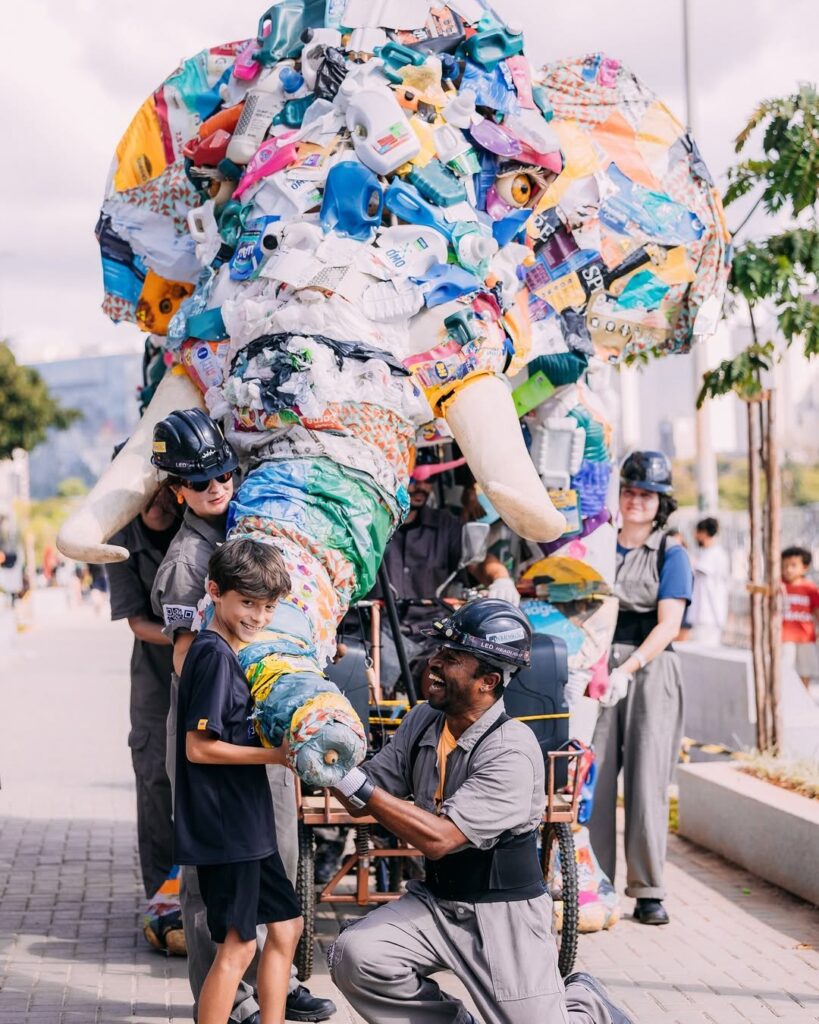
The figure of an elephant made of disposable materials, part of Virada Sustentável 2025, in the city of Belo Horizonte, Minas Gerais, Brazil | Photo by @viradasustentavel via Instagram
In 2025, Brazil will host Latin America’s largest sustainability event for the 15th time, called Virada Sustentável – which can be roughly translated as ‘Sustainable Week’. Since 2011, the initiative’s main goal has been to integrate art and culture with sustainability, drawing the society’s attention to socio-environmental issues.
The project travels through many states and cities, in order to attract a diversified public. This year ‘s first stop happened in May, at the city of Belo Horizonte, the capital of the state of Minas Gerais.
The most recent event took place in September, where São Paulo hosted the program. The project ran from the 17th to the 21st in various locations through São Paulo, the largest metropolis of South America, promoting sustainability through art and knowledge.
André Palhano, creator and co-founder of the event, highlights that the main goal is to handle the theme with a more of an optimistic approach.
“We have an important mission to ‘enchant’ people to sustainability, rather than ‘scaring’ them. Maybe, showing the amazing world that we still have can be more mobilizing than simply showing the terrifying world we’ll have if we do nothing.”
The 15th edition has many free, creative activities, which look out for the mix between art and sustainability to the discussion of themes like socio-environmental racism, conscious consumption and urban mobility.
Among the highlights of the program in São Paulo, there was:
Subscribe to The Superhero Brief!
Free access to the CEO's newsletter.
The views expressed in this newsletter are those of the CEO and do not necessarily reflect the views of the organization.
Musical performances by artists like Mariana Ahdad and Thiago Ramil – whose debut album Leve Embora earned a 2016 Latin Grammy nomination.
Dance, theater and music performances;
Discussion groups, lectures and workshops;
Furthermore, Virada São Paulo included exclusive participation, like: Claudia Visoni, journalist and activist; Rodrigo Perpétuo, executive secretary of South America ICLEI; and Kamila Camilo, founder of Oyá institute.
The programming was prestigious to the most diversified number of artists. On September 19th, the visitors could enjoy a tribute made in honor of the Hip-Hop’s 50th year anniversary.
During the day, plastic expositions were shown, made with the goal of transforming trash with creative potential, raising questions about consumer habits. Through the night, a music event took place, connecting the public to the diversity of Black music.
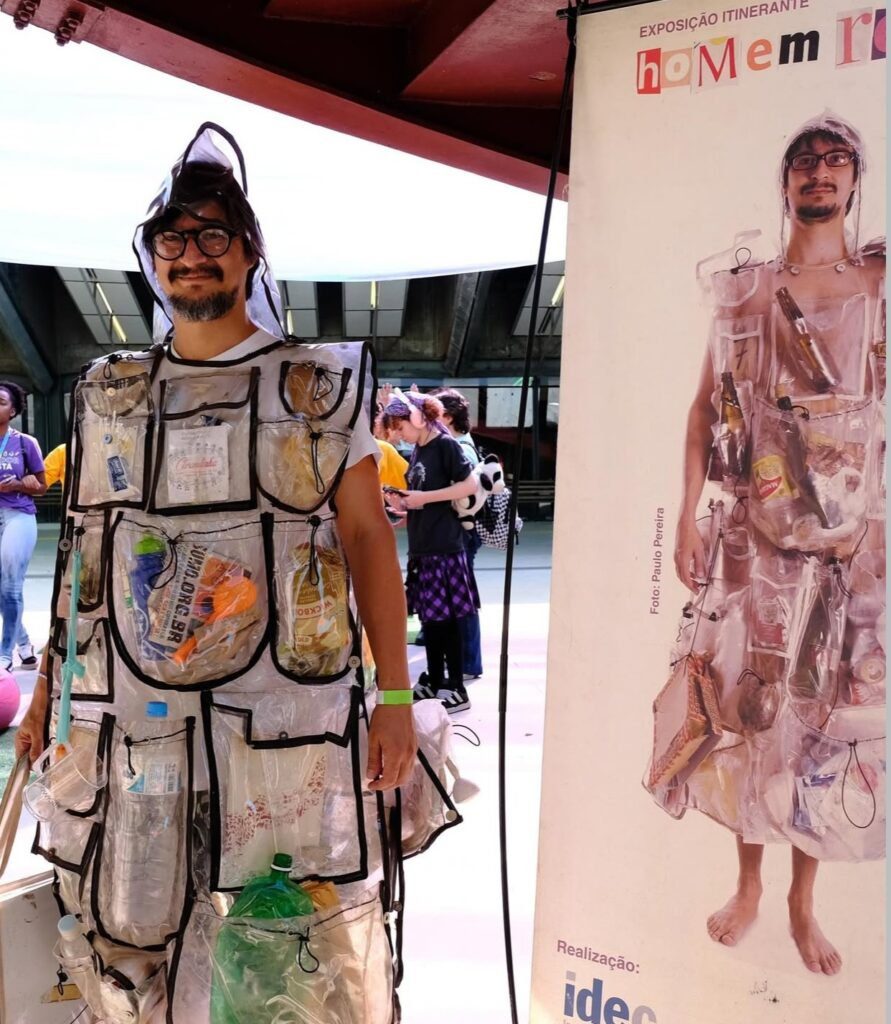
Many other artists were present. Between them, the artist Peri Pane, with the piece “Reflux Man”. Made in 2003, the project emerged from one of the artist’s ideas: during a week, he kept all his trash in a transparent plastic cape, made by the artist Mariana Reis.
It’s an artistic manifestation that seeks to provoke a reflection about the impact of individual consumption and the citizen’s responsibility with its own trash.
The artist Peri Pane (Photo by @peri_pane via Instagram)
The young Esther Dagápito told Yuvoice the most impactful moment of her experience at the Virada Sustentável.
“To me, the most impactful thing was the diversity of activities and the way that sustainability was thought beyond traditional molds, understanding that it is necessary to listen to plural voices to think about a better planet.”
Esther highlights an important aspect of the event: the activities focused on children. There, kids were able to have a dynamic contact with the climate agenda through games, dynamics, picnics with songs aimed to their ages, and much more.
“I was struck by the number of activities geared toward children, something that isn’t common given that children aren’t always included in this debate. As the producer of a collective focused on well-being, art, and regeneration that organizes activities for children, I consider the presence of children essential,” concludes Esther.
The program also stood out for its strong Indigenous focus. On September 21st, the city hosted an art fair dedicated to the native population of the country, featuring Indigenous people from Jaraguá Jardim. Additionally, Paulista Avenue hosted fairs, thrift stores, and discussion groups with Indigenous activists.
On the last day of the event in São Paulo, Txai Suruí, an Indigenous leader of the Paiter Suruí group, spoke about the need for debate on issues such as climate emergencies.
“This topic must be increasingly strengthened, whether by municipal, state, or federal governments, or anyone else,” she stated.
Txai Suruí advocates for a more observant approach to those suffering the consequences of environmental change and also for the need for government accountability regarding these factors.
“It’s necessary to discuss quality, pesticide-free food. It’s necessary to discuss vulnerable communities, where environmental impacts are first impacted by floods and landslides. […] All of this relates to what’s being discussed in these global forums and what’s being decided in the Chambers of Deputies and the Senate.”
In 2025, Brazil has the opportunity to become a benchmark in international cooperation for sustainable development through joint actions that seek a more just society and a balanced climate.
This initiative gains even more relevance this year, as the country hosts the 2025 United Nations Climate Change Conference (COP30), a global event that discusses solutions to the climate crisis.
The Virada Sustentável 2025 program is organized around the question “what is important to report on climate change and sustainability?”, reinforcing the connection with the UN Sustainable Development Goals (SDGs).
In an exclusive interview with Yuvoice, André Palhano emphasizes the importance of the event in 2025.
“This is the year in which we have seen, by far, the largest number of events related to this topic in several cities, certainly due to COP 30. But the curious thing is that many of these events and their promoters don’t communicate with each other, and don’t engage in dialogue. This led us to a challenge: to make this year’s edition of Virada a meeting place and an exchange of experiences among the different stakeholders in the cities, whether from the public sector, the private sector, or, above all, organized civil society.”
After the conclusion of the event in São Paulo, Virada Sustentável will travel to other cities in the coming months. Rio de Janeiro, Porto Alegre and Belém (COP30 host city) will receive the program until the end of the year.


Comments
Be the first to share your thoughts!
We value diverse perspectives and respectful debate.