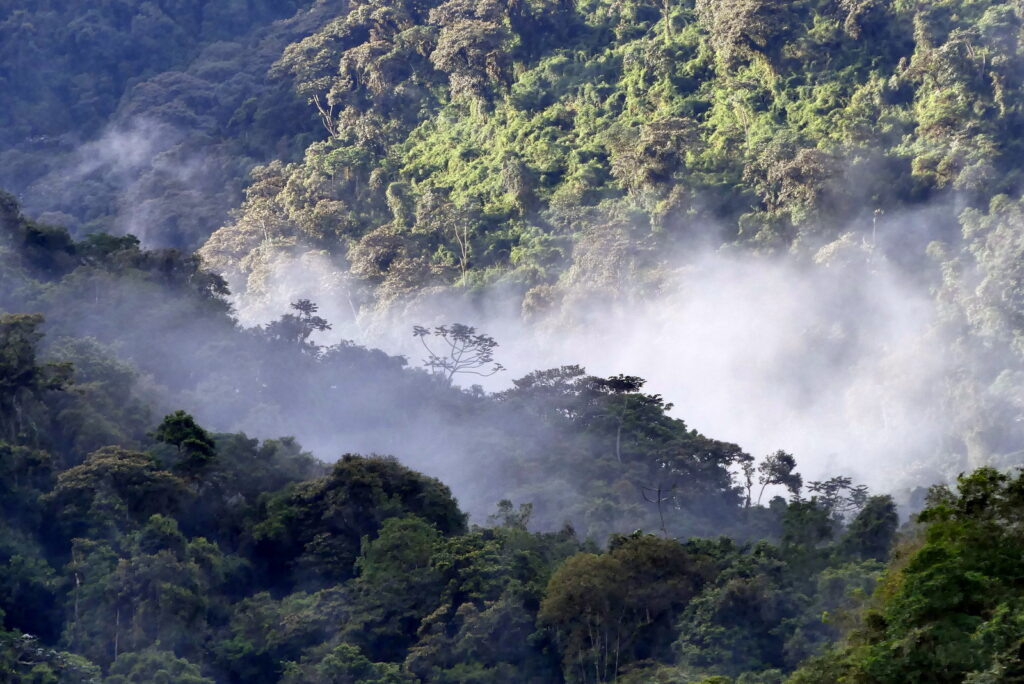
In the Ecuadorian Tropical Cloud Forest, where wax palms sit high above the canopy, wreathed in mist above great green mountains, there lives a creature the size of your thumb.
The Intag Resistance Rocket frog or Ectopoglossus sp nov., a species new to categorization, was first documented in 2019, three years after the discovery of the thought-to-be extinct Longnose Harlequin frog (Atelopus longirostris). The name of the former was chosen after an international contest to name the species.
Because Leonardo DiCaprio has posted several tweets supporting the conservation of the region, people started to call the Longnose Harlequin frog (“rediscovered” there in 2016) after him, aka the “DiCaprio frog.” The Harlequin frog, first described in 1868 by Edward Drinker Cope, was rediscovered in March 2016 by researchers in the Junín area of Ecuador’s Imbabura province.
Giving rare frogs names after celebrities isn’t new; a similar honor was given to James Cameron in 2012, when a Venezuelan frog was named after him. Do you need to be a big-name A-Lister just to be able to save Earth’s creatures great and small? As DECOIN’s story tells us, you do not have to be.
Worlds away from Pandora
In the mountainous cloud forests of Intag in Ecuador, DECOIN (Defensa y Conservación Ecológica de Intag), led by Carlos Zorrilla, is its own kind of “Cameronian” story. Socioeconomic conditions in the Andes echo James Cameron’s blockbuster series, “Avatar”: mining corporations, the deployment of paramilitaries used to harass a native population, and a struggle for the soul of the land. Only here, there are no space aliens or denizens of a planet connected through a hive mind.
Subscribe to The Superhero Brief!
Free access to the CEO's newsletter.
The views expressed in this newsletter are those of the CEO and do not necessarily reflect the views of the organization.
If Cameron, who visited the Arara tribe in Brazil in 2010 to support indigenous communities protesting the construction of a dam, were to make another movie about real people fighting against mining, I would hope such a film would feature those in the Intag region, like Zorrilla, Sylvia Selger, and their colleagues at DECOIN.
The path of resistance
Founded in 1995, DECOIN is a grassroots organization that aims to protect biodiversity in Intag by, among many other things, establishing community-owned watershed reserves. In doing so, it provides locals with safe drinking water and, in some cases, sustainable alternatives to mining in the Intag-Cotacachi-Imbabura region.
They are a non-corporate entity that resists destruction brought by large mining corporations and empowers locals to protect their own water supply and biodiversity. In the “Avatar” films, the hero Jake Sully adopts the local customs of the Na’vi to help them keep their land. DECOIN uses a similar tactic: giving the locals back what is theirs. It isn’t always filled with Hollywood explosions, thankfully, but it is deeply strategic.
In Zorrilla’s “manual of resistance”, the primary tactic against mining corporations is simple: protect your land. He wrote the manual “so communities know what to expect when mining or petroleum companies show up at their door.” He tells me that he wanted to “give some ideas as to what to do about it.” Zorrilla’s manual has been translated into several languages so as to reach a broad audience. You can find the manual in the link in this paragraph or download it from the miningwatch.ca website. (It is written for activists, so the language might be strong. Please be advised.) Select “publications,” and search for “protecting your community” (with quotes). The supplement is available there as well.
As the manual describes: “The company will often attempt to buy … key properties. They may offer high prices for land to win over residents and to weaken the resistance. Sometimes they will buy land gradually… Or they might try to rent the land for many years… they can just pick up and leave when they’re done without having to clean up”.
To counter this, Zorrilla and his team pioneered what he calls “the most successful conservation measure”: buying up the land and giving it to the communities. “Not for us to protect,” Zorrilla told me in our interview, “but for the communities and local governments. Since they have more at stake, that’s where they get their water.”
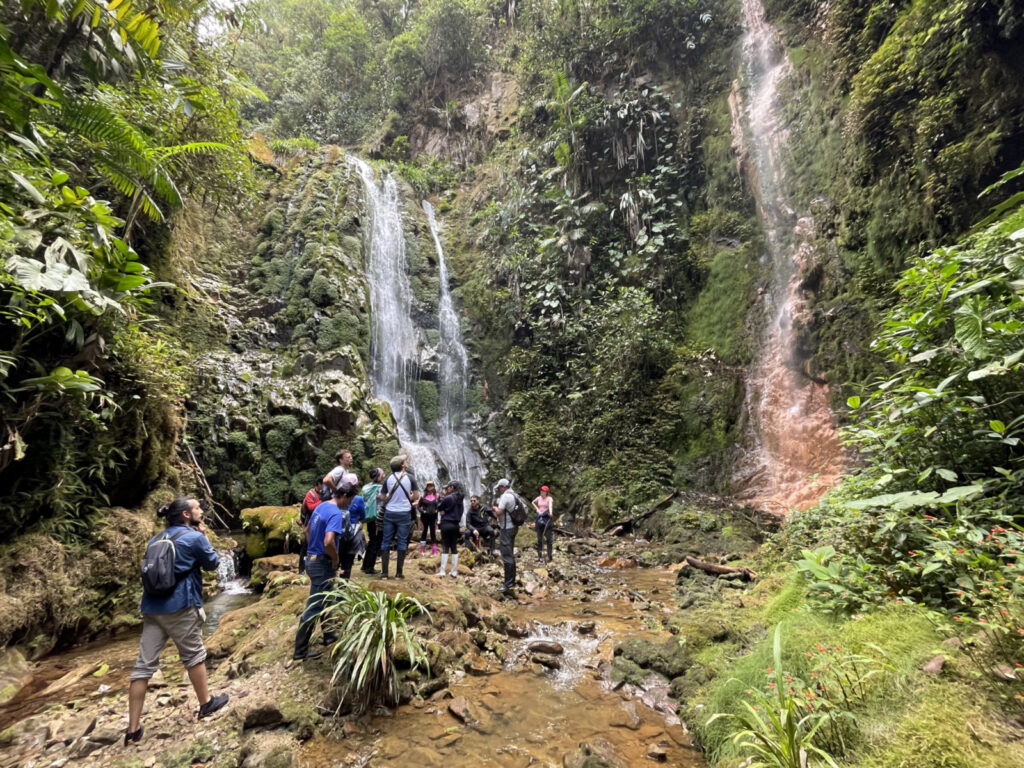
(Image courtesy of Carlos Zorrilla, DECOIN)
Though the world often focuses on the vastness of the Amazon, the cloud forest of Intag is a niche area of even higher density. Sylvia Selger explained the biological math during our talk: “The cloud forest is a tropical mountain cloud forest. These forests are known for being very, very diverse. They have more endangered species per square kilometer than the Amazon.” Because these forests are islands in the sky, evolution has created life forms found nowhere else.
In the cloud forest, Intag’s Resistance Rocket frog is a legal giant. In 2008, Ecuador became the first country in the world to enshrine the Rights of Nature in its constitution. This shifted the legal landscape from nature being “property” to nature being a “subject” with the right to exist, persist, and regenerate. “In my eyes, the Rights of Nature is, in essence, a momentous shift of paradigm, from an anthropocentric way of experiencing the world, to an ecocentric vision, in which other species and elements of nature have equal standing in the courts,” says Carlos Zorrilla.
By proving that mining activities would inevitably impact species like the Longnose Harlequin frog and Intag’s Resistance Rocket frog, DECOIN provided the scientific testimony to the courts that the resilient inteños — the people of Intag — needed to halt the mining projects. For the comuneros (community landowners), these aren’t just scientific data points; they are the neighbors with whom they share water.
Small is beautiful
DECOIN’s resilience through staying lean is genuinely inspiring. Many other environmental organizations survive by receiving CSR or ESG funding and are tied to corporate interests. DECOIN survives by staying focused locally, no frills.
In his own words, Carlos told me that “Small is beautiful.” This philosophy protects the movement. When the government harasses him to advance the agenda of mining companies, they find that DECOIN has no major funds and cannot be traced to an illicit agenda. “We are not an NGO,” Mr. Zorrilla explains. “We are a grassroots organization. Unlike some of the big NGOs in the big cities that visit the sites they support, driving big expensive SUVs, our organization does not own a vehicle. Most of our members only travel by bus, and our office, which we only open one day a week, is tiny.”
His colleague Sylvia Selger says that DECOIN has “almost zero overhead.” Both she and Zorrilla “don’t get a salary from DECOIN, and we are paying one worker a wage.”
When I asked if they have a Patreon, they both told me they do not. They rely on a network of trusted friends and partners to source funds when their community needs it, so there is complete transparency and trust in a tight-knit group. Carlos tells me, “This establishes us as a reliable partner. If a community needs urgent funding, we’re able to give it to them without having to go through all the horrible paperwork that most organizations are forced to do. This is more important these days, since the government passed legislation to go after NGOs that oppose mining projects. So, we don’t really, we’re fine. Very small, very few people, and we are from the area, people know us, and we can have a quick response to threats.”
“We want to keep it that way. Small is beautiful. In this case, small is beautiful.”
Small does not mean powerless, as history in Intag has shown. Even as something as small as a frog can be major proof for the case of nature’s rights, smallness was also not an obstacle for the United Nations Development Programme to grant DECOIN the prestigious Equator Prize in 2017.I hope that as long as DECOIN stays “small,” the small things like the Resistance Rocket frog and the people of Intag (inteños and inteñas) have a chance.
For more information about DECOIN and its impact, visit their website here.Carlos Zorrilla also recommends that people watch more documentaries about DECOIN’s struggle in Intag on YouTube, including this Mongabay one.
Danial is a literature graduate seeking to write more. He is from a small Southeast Asian country called Brunei. He graduated in Australia and was a teacher in Japan for six years



Comments
Be the first to share your thoughts!
We value diverse perspectives and respectful debate.