
HUMANITY

When Home Is At War

I am sitting in my office.

Outside my window, the day is ordinary. Students walk across campus carrying coffee cups and backpacks. Colleagues pass by, discussing research, deadlines, and conferences. My inbox keeps filling with emails that expect replies. Life continues exactly as it should.

Thousands of kilometres away, another war has begun in my country.

I have lived in exile for almost four years.

When I left Iran, I imagined many possible futures. But I never imagined this would become the future of Iran.

Distance creates a peculiar kind of helplessness. When tragedy unfolds around you, at least you know what to do. You look after your family. You stand beside your neighbours. You share danger with those you love.

Exile removes even that.

You refresh the news.

You wait for a message that never gets sent and never arrives because the internet has been shut down.

You calculate the time difference and realize that your family should have called by now, but the phones are silent too.

Then you remember what time it is there.

For them, the longest hours are only just beginning.

The attacks often begin after midnight.

While my day unfolds without incident, their night is filled with uncertainty.

I watch the names of cities and towns appear on the news — places that belong to my country, places whose names I have known since childhood,  many that I never even had the chance to visit before I left.

There are rumours that military operations may begin from Hormoz Island.


It is Hormoz, not Hormuz

The last place I visited with my family before life carried me into exile.

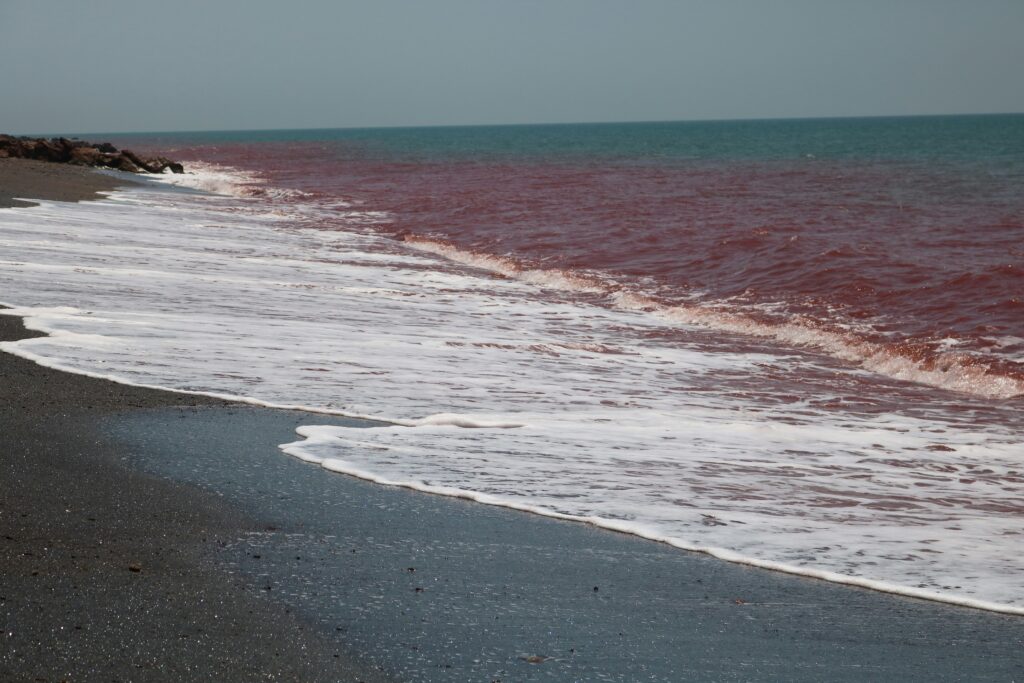
I still remember its red earth, the colours of the mountains meeting the sea, and the feeling that I had only just begun to discover it. I promised myself that one day I would return, not for a short visit, but to stay for a while; to wake up every morning surrounded by that extraordinary island.

Now, when I hear its name mentioned alongside words like occupation and war, I cannot stop my tears.

Part of my heart is still there.

Perhaps that is another meaning of exile.

You do not only miss the people you love.

You grieve the places that continue to live inside you, even when you are no longer there to protect them.

Every new place name becomes another question.

Who is there?

Who is waiting for morning?

You search maps.

You search social media.

You hope someone, somewhere, has written, “We’re safe.”

Sometimes, there is only silence.

And then, somehow, you are expected to return to work.

You answer emails.

You review manuscripts.

You attend meetings.

You smile politely at colleagues.

Your body is here.

Your mind has travelled thousands of kilometres away.

For a long time, one question kept returning to me.

What can I possibly do from here?

I cannot stop missiles.

I cannot negotiate peace.

For a while, I confused helplessness with powerlessness.

They are not the same.

Helplessness is the feeling that nothing you do will ever be enough.

Powerlessness is choosing to do nothing.

Gradually, I realized that although I cannot stop a war, I can still decide what I do with the freedom I now have.

As a scientist;

I can speak about academic freedom.

I can document the stories of displaced scholars.

I can support researchers forced into exile.

I can remind universities that behind every fellowship application is a human being who has lost much more than a job.

None of these actions end a war.

None of them erase suffering.

But perhaps they prevent other things from being lost: memory, dignity, knowledge, and hope.

Living far from home teaches you a painful lesson.

No single action changes history. But history is also made from countless small acts of refusing to look away.

I still don’t know whether what I do is enough. Most days, it doesn’t feel like it is.

But perhaps that is the wrong question.

Perhaps the question is not whether we can stop every tragedy unfolding in the places we once called home.

Perhaps the question is whether we choose to use the safety, freedom, and voice we still have for those who cannot.

Because exile may take you away from your country.

It should never take away your responsibility to it.

Editorial Acknowledgments

Thank you to Daphne Kasriel for her inspired edits on the piece.

READ MORE

Comments

Be the first to share your thoughts!

We value diverse perspectives and respectful debate.