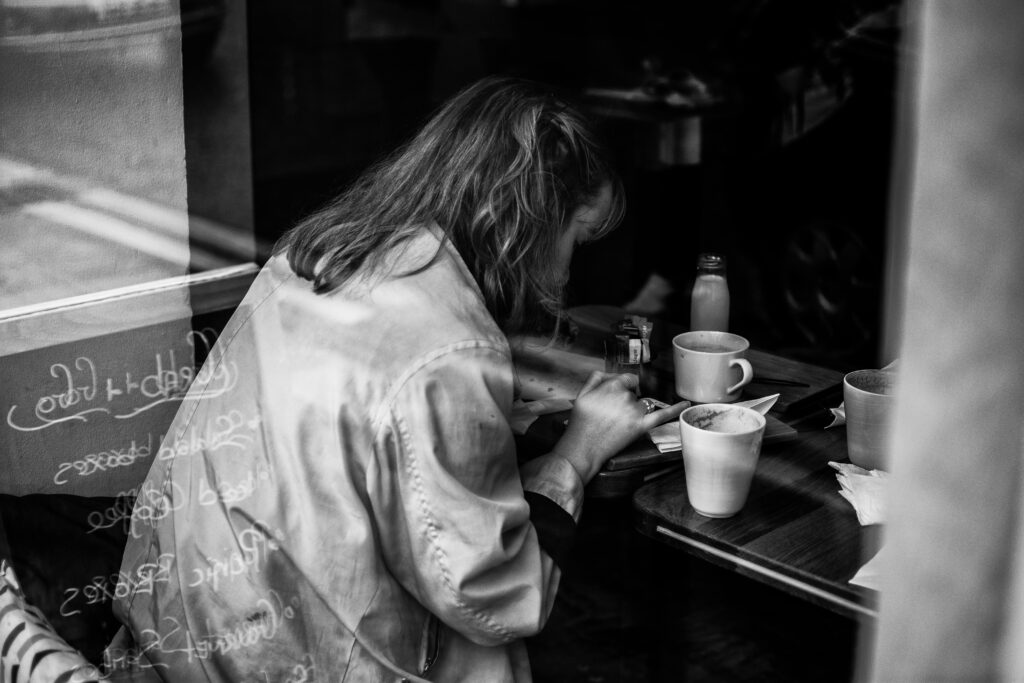
In a coffee shop a woman sits, head bent, knotted and frizzy blonde hair cascading down her back. A claw clip clings to it with little purpose: impotent, listless, one tooth broken at the root.
Besides her sit a cup of coffee and a laptop. She hates the artificial light it generates: a swinging metronome, pulling her face toward the glare, frying her retinas.
Well, out of sight, out of mind, she thinks, and slips it into her backpack. But the burn behind her eyelids still sears.
She pulls out a notepad; wrinkles her nose in distaste at the sight of her own messy handwriting. Why can’t she have beautiful, flowing script like other girls? Effortlessly curly and smooth (their hair always the same — no frizz in sight) half cursive: one letter making love to another, forming a sensuous breath, an uninterrupted thought inhaled and exhaled in harmony.
Poetry ought to hold hands with elegant script — not chicken scratch.
But what was the word she was looking for?
Her moonbeam shouldn’t just glisten or gleam; but perhaps illuminate? Luminate? Effervesce?
Too highfalutin, she thinks.
Use simple words — you aren’t a Victorian novelist. No Brontes here. Hadn’t they written all their best works by the age you are now? You, on the other hand, have written nothing.
She decides on “shimmer” with distaste.
Across the shop, a middle-aged woman sits on a sofa. Her latte lays untouched on the low table before her. She is deeply uncomfortable and utterly ignorant of her own feelings — her whole awareness taken up with wishing her cell phone would ring, though she knows it will not.
Subscribe to The Superhero Brief!
Free access to the CEO's newsletter.
The views expressed in this newsletter are those of the CEO and do not necessarily reflect the views of the organization.
Her daughter, after all, is busy. Her daughter doesn’t need her. Her daughter is just fine.
Somewhere, on the other side of the country, she sits — like that girl to the right maybe — writing a beautiful paper that will get an “A.” And she will call home happy about it, someday. Just not today.
Though Ashley takes much better care of her appearance, she thinks, spotting the claw clip. That’s the way she was raised: “You have to put your best foot forward,” she always told her daughter.
She wishes Ashley would call more often. She wishes even more that she did not resent her for not calling — children must be left to live their own lives — but then, on the other hand, didn’t their parents deserve more than to be treated like an ATM?
Maybe I did something wrong when she was growing up, she wonders, thinking back into a blurry abyss where memories sometimes rose to the surface with painful clarity.
Though she is ashamed of it, she often snoops in their joint bank account. She had seen the bill the day before: mental health solutions, psychotherapy. She knows what people talk about in those sessions — about all the things their parents did wrong — every unintentional trauma they imparted, the spankings they had given. Well, hadn’t everyone told her it was good to spank her children then? Hadn’t her own parents done it to her, sometimes with a belt? It had never crossed her mind to resent them for it.
But children were different now because now was a different time. They believed in looking deeply into every feeling and rooting out every pain, rehashing every conflict. They had no idea what a great luxury it was to be able to do so.
She remains unconvinced, no matter what Ashley says, that it is always better to uncover than to bury. Her coffee grows cold, so she forces herself to drink it, mechanically.
A little boy runs back and forth across the shop, from his Mother, seated at a bistro table outside, through the heavy door (he must push hard, like Superman, to make it move) to the shelf of games. He runs his fingers over each game but chooses none because his legs are twitching to run and leap.
He dashes back again (fast, like a cheetah), catching a glimpse of a thin woman sitting beside the games. She has lines all over her face because she is old, and she looks sad. He forgets about her the moment he turns away and pushes at the door.
Mother sits reading, though he can feel her watching him, making sure he does not try to run across the street. He wishes they could play together, but knows she doesn’t want to.
He knows Mother more by smell and touch and sound than by sight — because she is always moving, and her legs are the body part he sees most. She is a skirt, a lullaby, a pantsuit, a warm hug, sometimes a stern voice, but always far above him, in a different sphere he cannot fully enter.
He kicks a pebble and sends it scuttling onto the street. He starts after it with abandon, but finds himself stopped, because Mother has grabbed his shoulder, though she has not looked up. She is omniscient, omnipresent.
She says, “Jeremy, stay.”
He looks longingly after the pebble, then at a bird in a tree, then at the pastries in the shop window. He runs back through the door, push, push, PUSH, and the shop bell jingles.
(Image Courtesy of George Becker via Pexels)
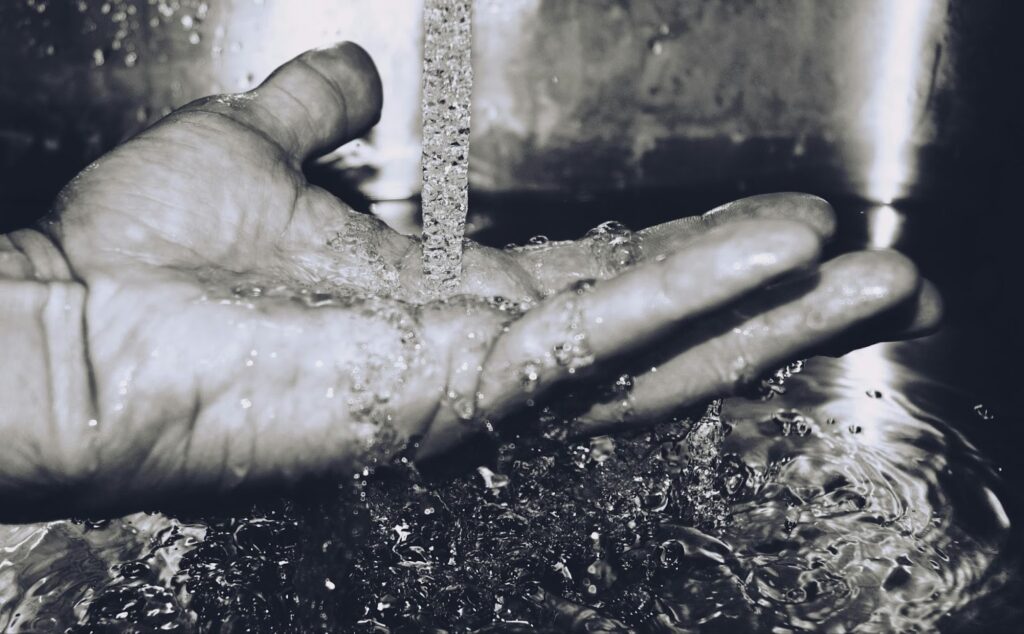
In the bathroom, a man eyes his bald head in the mirror above the sink — a rounded and reflective plain, speckled by only a few sickly trees that escaped the strip mall’s razor. He remembers that an astounding percentage of men don’t wash their hands. This makes him feel a little bad for women, and a little bad for himself, too.
Well, he will scrub his hands proficiently, though considering he is about to touch the door handle (urine-bespeckled, undoubtedly) he is not sure it matters.
Everything in life comes out the same, no matter how hard you try, he thinks. What was the point of being good or right in a world where everything is contaminated already — the planet, more or less a castle of bacteria, growing far too fast to be cleansed by soap and water?
A losing battle, he decides, drying his hands.
All this time his eyes have rested on the fruity-flowery wallpaper covering the single-person bathroom: the peaches a warm, burning orange, the cherry blossom petals a delicate, breathy pink, the leaves and vines a cool, comforting green. He is acutely aware that because he is a man, he should not like this wallpaper, but that, unfortunately, he does like it, just like he likes white mochas and peach Bellini.
He walks out of the bathroom and sees a little kid bolt through the shop door, making the bell tinkle. Once upon a time, he was that child, a whirlwind of energy, a flame cruelly contained by kerosene-glass.
Always shattering, screeching and weeping — though the weeping had only continued ‘til seven or so, when he came to understand the cringy weakness of it. He still cried, of course, but only silently, alone, at night. If no one hears a tree fall, does it really make a sound?
He has a theory that “good” men continue to cry into adulthood, even if forced to do so in private. Those who dry up their ducts transform into gods of burning rage… the price of evaporating human tears.
Unless he is self-deluded, and the wallpaper and crying mean something else entirely. He has often wondered if he is gay. Hadn’t softness and sensitivity — however hard he fought against them — permeated his life? The problem with this theory is he doesn’t really want to have sex with men. But considering the repression and homophobia of most males, how can he know for sure? Everything he believes about himself could be a lie — the truth hidden deep beneath layers of societal guilt and shame.
Maybe, even now, his perceived attraction to the girl in the corner — he watches her as she rips through notebook pages, dotting “I’s” and crossing “T’s,” viciously dashing out whole sentences — is all a sham. Her knotted hair reminds him of brambles on the edge of a lawn, encroaching into the landscaping, squelching non-native plants, reclaiming the wild.
It must be this wildness that bewitches him, that enters his body like an evil spirit and drags him across the room to her. Hitting on women in coffee shops is too bold and deeply out of character for him. Watching his body stroll over to her, he considers if his real intention is to reassert his heterosexuality.
Standing at her table, alarmingly close to her, he realizes he has nothing to say. Mercifully, not only does no sound come out when he opens his mouth, but the girl, absorbed in her art, seems unaware of his presence. Before she can look up, he turns and hustles toward the door.
(Original image courtesy of RDNE Stock project via Pexels)
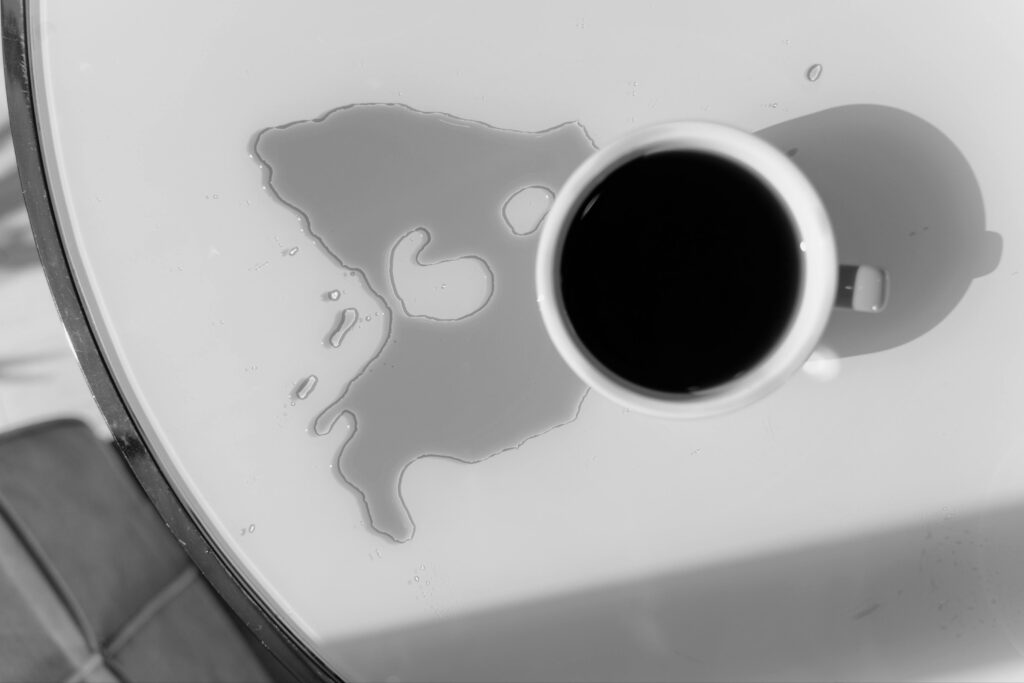
On the way out, he nearly runs into the little boy, bolting outside again. He shifts his balance to prevent collision, nearly falling, and careens into a low table, upsetting the coffee cup of an older woman. She looks up at him with tight pursed lips and wide, startled eyes.
“Oh shit, sorry about that,” he says, trying to help her clean up the mess. But she waves him away, saying nothing. He is left to drift toward the door, knowing himself a failure.
The commotion makes the writer come to herself again. She sees the older woman soak up her spilled coffee with napkins, the child outside pull at his mother’s pant leg, and the younger man disappear through the shop door with a clang.
Even from behind she can tell he is attractive — broad shoulders, a nice butt. Why can’t anyone like that ever notice me? she thinks.
He’s probably gay, she decides. He’s dressed too nicely to be straight.
She turns back to her page, buzzing with discontentment. One more cold, hard letter written, and her hand stills. Her pen has run out of ink.
Sofia Tietze loves the written word. She’s passionate about reading, writing, and editing the works of others. She received a bachelor’s degree in English (with an emphasis in creative writing) and a minor in professional writing from UC Davis and currently works by day as a medical editor. By night, she’s writing down her debut novel and whatever poem happens to possess her. On weekends, you can find her riding her pony in the Sierra Nevada or biking through Sacramento in search of new coffee shops and thrift stores.
Thank you to Amber Rhodes and Jarrod Wetzel-Brown for their inspired edits on the piece.



Comments
Be the first to share your thoughts!
We value diverse perspectives and respectful debate.