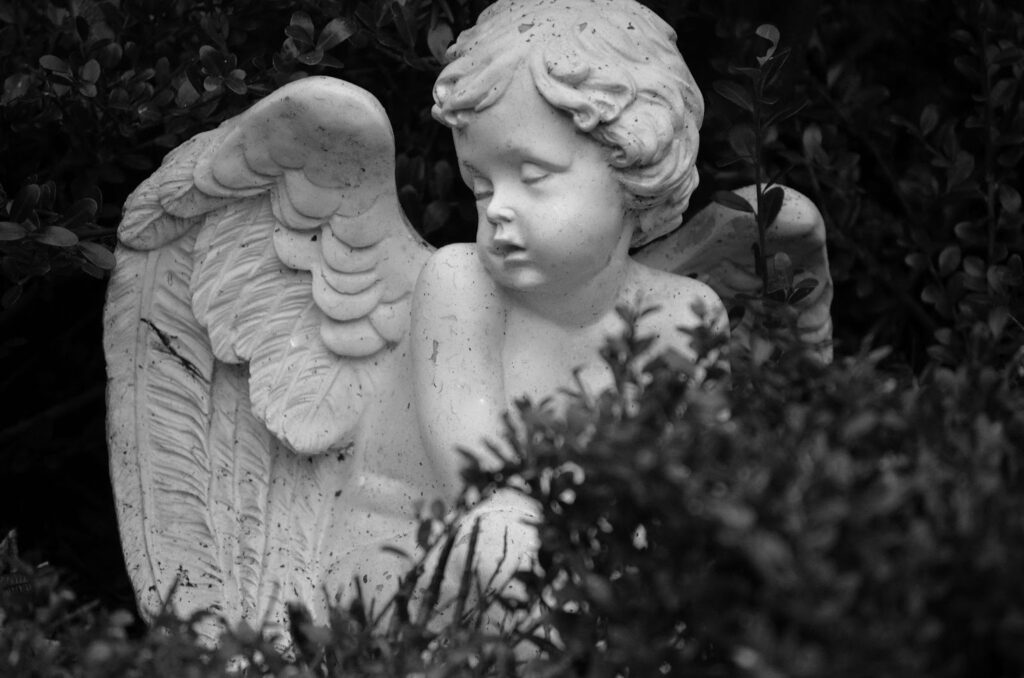
The biblical gardens were a fairyland. In Jean’s imagination, no one had planted the flowers, engraved the stones, or bought the benches: they had all appeared out of thin air. An angel had flown down from heaven, touched the land with a long, shining finger, and Eden had sprouted, flourished.
Mother often took Jean there to paint. “I could live without the overt Christianity,” she always said, “But something about this place calms me down.”
Jean played along the paths, in the creek, puzzled over the Bible verses, scattered throughout the garden – etched on rocks, displayed on wooden signs – as natural and essential to this place as the colony of ants that lived beside Mother’s favorite bench. Mother spent most of her time sitting there, overlooking the waterfall, often painting it, but sometimes staring at the signs with a sad, sour look on her face.
From a young age, Jean knew the real reason they came here was Grandma.
“I would have scattered her ashes here if the old bitch hadn’t insisted on being buried,” Mother told Jean again and again. “It would have been cheaper and nicer, but nope, because it would be easier on me… fuck it.”
Then she would sketch a flower, butterfly, or sometimes children playing in the garden. But none of the pictures, no matter how beautiful they were, made anyone who saw them happy. Even the butterflies, still and scrawled, came away looking sad.
To this day, one of these sketches hangs in Jean’s hallway, and she stops to look at it sometimes, just to remember the burden her mother had to carry.
Subscribe to The Superhero Brief!
Free access to the CEO's newsletter.
The views expressed in this newsletter are those of the CEO and do not necessarily reflect the views of the organization.
In the picture, three children run down the trail, past Maudlin’s empty bench. The face of the first, a tall girl with curly brown hair that streams behind her as she runs onto the bridge crossing the creek, cannot be seen. The second is a little boy, mid-trip, his hands falling down in front of him to catch himself, his profile also not visible.
Maudlin is the third – drawn to impart the liminal: a grown-woman’s countenance plastered on a little girl’s body – turning around to stare at the voyeur looking in. Her mouth hangs open like a trap door, her eyes wide and globular, like two green planets; her arms hang limply at her sides, flopping, as if they have no bones.
…
The path through the garden is aided by several bridges, which allow the walker to zig-zag back and forth over the creek. The second, a dainty wooden arch that crosses the stream nearest the waterfall, sits deep in the garden, while the first, broader and well-worn, stands at the entrance. The thudding of Jean’s feet against the wood, drowning out the noise of Highway 49 behind her, seemed to herald her arrival, making her journey into another world complete.
A big sign that hung over the first bridge said: “Taste and See the Goodness of the Lord.” Mother always made a face whenever they walked past it, but Jean liked the idea of a god-garden. And she understood what the sign meant, too: when you experienced art, you couldn’t help but learn about the Maker.
Jean invited Jules to come with them, but only once, because not only did Mother find him annoying – “That kid talks so much about reptiles it makes me want to kill myself” – but also because Jean rightly recognized that he would be incapable of respecting the sanctity of the place.
You didn’t run in these gardens, she tried to explain, you were meant to walk slowly. Nor did you shout – you spoke in low, dulcet tones.
“It’s like church,” she warned him, “solemn.”
“You don’t go to church.”
“My grandma took me, when I was really little, like 3 or 4.”
“You can’t remember that. That’s too little to remember.”
A hazy world, blurred at the edges, like a dream:
Thick lights, streaming through the stained glass, illuminated the face of the baby, whose mother held up for all to see. She looked sad. Were all mothers sad?
Little boys, at the front of the church, dressed in white, singing like angels, or doves; the tone of each voice building on another, climbing higher and higher, further and further upward, till the whole church swam in music, till the sound, crystalizing at the tippy top of the high-ceiling, threatened to burst through the roof and obliterate the chapel in a violent, vibrating melody.
The big wooden cross loomed at the front with a man dying, sweating beads of blood – ever after. When Jean thought of her grandmother, she thought also of the statue of that man, because a moment after spotting him she turned her eyes to the ground and was shocked and frightened to find her grandmother on her knees, opening and closing her mouth without words, crying. Jean had never seen her cry before and would never witness her doing so again.
She almost reached out her little hand, like one might reach for a blooming cactus, before she remembered the touch would hurt. And her eyes again rested on the wooden cross. Jean wondered why on earth that poor man was up there, half-naked and sweating blood. And why all these people stared at him.
She asked Grandma, after service, who he was.
“That’s God,” Grandma said solemnly.
And for some reason it made sense to Jean that God was mutilated, that he bled.
“I hate church,” Jules said. “It’s boring.”
“You’ll like it here though,” Jean reassured him. “There’s a creek. And lots of lizards.”
“Well, alright,” Jules said, “I’ll come if I have nothing better to do.”
Jean frowned at his lack of enthusiasm.
…
Jules insisted on racing from the car to the garden, which confirmed that Jean’s decision to invite him had been a grave mistake. Still, it did feel wonderful to run, with her hair streaming out behind her and her feet thudding bombastically on the wooden bridge like the music of an off-beat drum. She didn’t race past the world; it bolted by her, elegantly topsy-turvy, with the speed and swiftness of light and wind.
Then her feet landed on the soft, spongy grass with relief. She wanted to sink down into it and grow burrowing roots for the cool, dark earth to hold.
Jean collapsed on the bench closest to the entry way as Jules finally came sprinting across the bridge, huffing and puffing.
“I beat you!” Jean gasped, triumphantly.
“Only ‘cause I let you win,” Jules wheezed. He took out his inhaler and brought it to his mouth, inhaling long puffs.
Jean saw Mother far away, still lingering in the parking lot, fading into the background like a tree or moss-covered rock. And the garden before her grew larger than itself—expanding into tangible imagination, a thought bubble solidified into a new, wild continent.
“I know what to play,” Jules said, excitedly. “We’ll be explorers, making maps and stuff.”
Jean considered this. “But why are there only two of us?”
“I don’t know, maybe everyone else died… and now we are running out of food.” Jules, in thoughtful contemplation, bit his lip. “You can’t be a girl, though,” he continued. “They wouldn’t have brought girls.”
“That’s not true. Lewis and Clark brought an Indian woman with them.”
“I can’t even say her name,” Jules said, “so she doesn’t really count.”
Jean frowned, wondering aloud: “It was an ‘S’ something…”
She suddenly felt it was important to remember, because this woman had existed – hadn’t she? – as much as Lewis or Clark, and she was actually more real than either of them, because she had been born from the land she traversed: sprouted up straight from the soil, rather than merely being someone who walked on top of it. Like the difference between herself and Jules – he stomped over and through places, but they never belonged to him or changed him in any way. But Jean became a part of the world she walked in, weaving a flower into her hair, scattering earth into the cuts on her fingers, welcoming water into her stinging eyes. Of course Jules wanted all the characters in the story to be stompers: unaware of the shrubbery they marred and the big boot tracks they left.
“Sacagawea!” she said triumphantly, remembering.
“Yeah, whatever. Don’t you want to play?”
“Why don’t you be the explorer, and I’ll be the Indian woman,” Jean said. “And I’ll help you learn to survive.”
In an uncharacteristic moment of self-assertion, she continued, ignoring Jules furrowed brow, and said, “We can pretend the creek’s the ocean, and you got shipwrecked here. And you don’t have any food. And if you want to survive you better become friends with me!”
Jean ran away then, ignoring Jules’ calling after her, because she didn’t want to argue, and maybe what she really wanted was to play alone – along the path, over the bridge, many waters gurgling underfoot, drowning out his voice. Up the winding trail (which ran parallel to the one Jules stood on but was separated by the creek), up the wooden steps and out of his sight – till she stood below the big wooden crucifix, with the image of the God-man, dying. She walked past him quickly because it made her sad to look at him, and continued to ascend the steps till she came to a stone table engraved with twelve men. The one in the center held out an ornate cup to the others, and the inscription sprawled beneath them, covering its length in fancy letters:
“This is my blood of the covenant, poured out for you.”
(Image courtesy of SK Stannik via Pexels)
The table and engraved goblet suggested to her a deep, disturbing magic. Witch doctors drinking the blood of their victims, magic spells and voodoo dolls, vampires lurking in the shadows. She connected it in her mind with that horrible scene in Narnia, where Aslan lay strapped to the stone table, murdered by the ghouls and goblins. It didn’t seem, for some reason, like Jules would be able to find her here. And so, in the brush a few steps beyond the table, in the shade of a large oak tree, she made her wigwam.
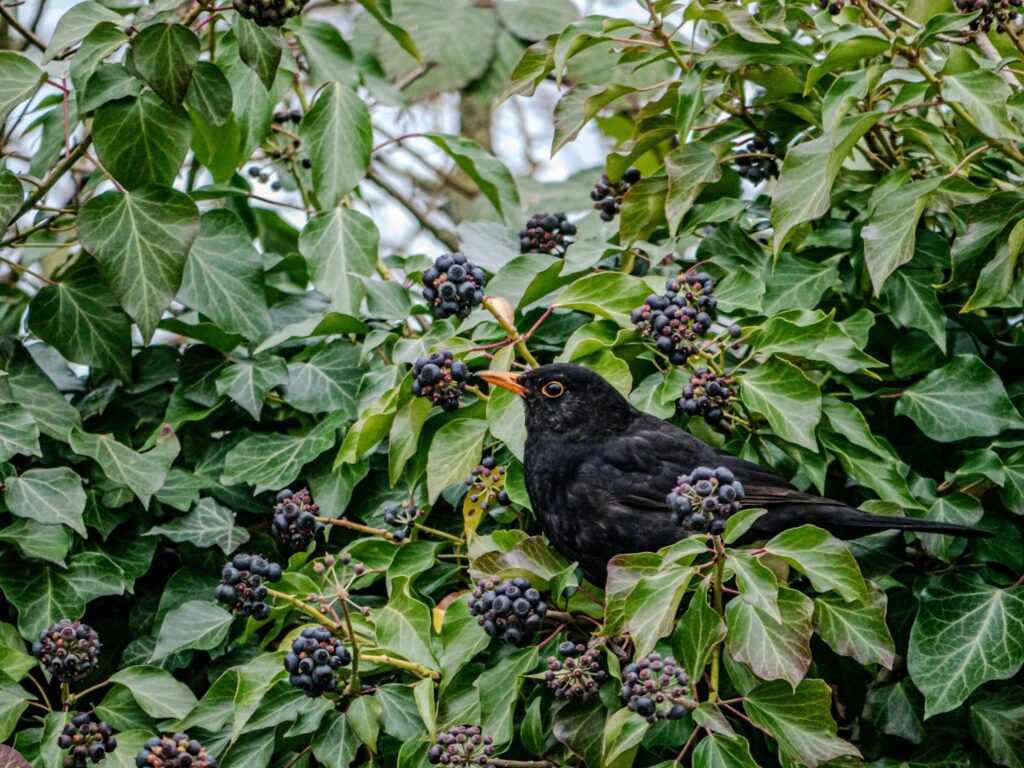
A tributary of the creek wound through this area, no more than a trickle this time of year, almost hidden completely by blackberry bushes. The big, shining berries dotted the branches, weighing them down. Carefully, she ventured into the thicket of thorny tendrils that tore at her clothes. Jean grabbed at the stems between the thorns and unstuck the fabric best she could. She plucked the berries nearest to her, one by one, from the bush, careful not to crush those which were juicy and overripe. But her delicate grip still pulverized many – resulting in a drain of dark, sticky blood flowing down her fingers.
Jean ate some and transported the rest to the stone table where she mashed them up with a stick. But upon poking her finger cautiously in the resulting juices and realizing the concoction was too thin and watery for her purposes, she knelt down by the nearly dried up stream and gathered some mud from the edges. Then, she mixed the mud with the mushed-up berries, creating a black paste.
One mark on the forehead. One on each cheek. One mark on the chin. Because the berries and the mud, cool and granular, now covered her skin, seeping into her pores, clogging them, she felt she knew the earth more intimately, like Sacagawea must have known it.
Jean heard Jules splashing in the creek, pounding on the ground with his feet in big, heavy beats, whooping and screaming loudly as he pretended to sail a ship on the seven seas. Everything he did affronted this place; his life force a chaotic reverberation that echoed throughout quiet earth and sky, silencing nature—scattering lizards, forcing birds to take flight.
She marked her hands with paste, then her forearms, in swirls of stars and moons, till black-red galaxies covered her body. If she were here alone, she would make a gallon of the stuff and lather herself, head to toe in it. She wondered if doing so would camouflage her and allow her to disappear against the backdrop of the ground, granting her invisibility. Or would the earth, seeing her skin turned to mud, recognize her as its own and swallow her whole?
The real world (where Mother lived, drawing somewhere, and Jules tramped) intruded on Jean’s solitude, limiting the scope of what she could become. It hung in the corner of her mind, frowning, reminding her always that she could not cover her whole body in mud and that she was not really an Indian. But her desire for this not to be true became so intense that, when Jules began to call her, Jean did not answer.
She was a Native American woman, cautious of this strange, noisy, pale man. She must not let herself be seen, but instead, observe the stranger, see if he was her friend or foe.
“Jean, where’d you go?” Jules called. His footsteps – thud, thud, thud – resounding from below, came closer. She must hide. Furtively, Jean slipped behind the stone table, behind the large wooden cross that overshadowed it, which marked the boundary of the garden. All that lay before her was a hedge of thick blackberry bushes. For a moment she felt trapped, until she realized: why shouldn’t these be her home? Wouldn’t the thorns, with white tips like teeth, protect her?
Only, they would hurt her, too. She cautiously grabbed one of the branches between the thorns, and then, with less care, grabbed another, accepting the painful pricks. She could hear Jules coming up the trail toward the stone table, closer and closer, so she abandoned all caution, covered her face with her arms, and waded head first into the blackberries.
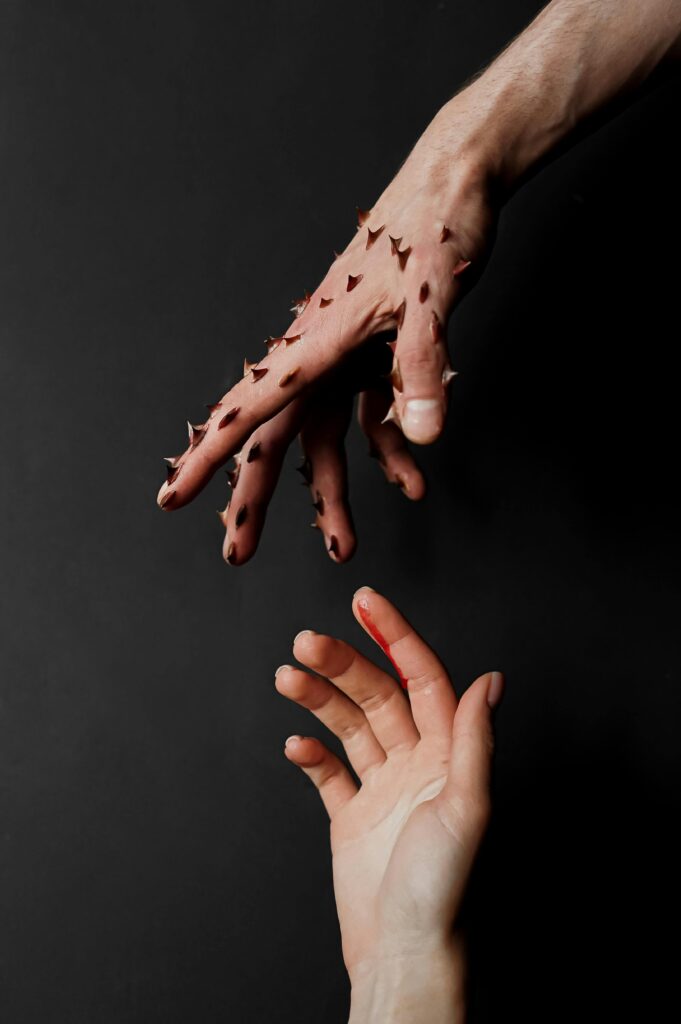
Thorns scratched and tore at her arms, legs, and hands, creating so many cuts that she didn’t know where to focus on the pain. But Jean kept going until she knew the shrub had become her shroud. She crouched there, in the middle of the bush, the thorns hovering all around her like hungry fangs, savoring her, so if she moved even a centimeter they gnawed. She watched as a big scratch on her bicep produced a thin trail of blood, quickly filling the fleshy, thorn-carved trench it originated from and overflowing, trickling down her forearm. Still, she remained motionless.
And Jules’ feet – thud, thud, thud. “Jean?”
He stood before the stone table, only feet away, but he could not see her. The ability to watch him, undetected, filled Jean with an exhilarating sense of power. She knew more than him – could see more; he was at her mercy.
He looked this way and that, calling her, a slight panic crouching in the corner of his eye. “Jean, where’d ya go? You’re always disappearing,” he howled. Frustrated, he kicked the stone table. “Ow! Ow! Owww!”
Jean, counting on his preoccupying pain, snuck out of the bushes as silently as she could and routed him from behind. She felt like a snake in the garden, quiet, crafty, shrewd.
His eyes rose from his foot; seeing her there; a millisecond’s pause to take in her form – the berry juice paint, the scratches, the trickling blood; then, a delayed scream, high-pitched, and a hop backwards, so he almost fell onto the stone table.
His eyes opened wider still. Jean pantomimed an imaginary bow and arrow, strung taunt and ready to fly at his face. “Jeeeeez Jean, how’d you…?”
“Shhhh,” she whispered, like a narrator speaking to her reader in an aside, “we’re still playing.”
Sofia Tietze loves the written word. She’s passionate about reading, writing, and editing the works of others. She received a bachelor’s degree in English (with an emphasis in creative writing) and a minor in professional writing from UC Davis and currently works by day as a medical editor. By night, she’s writing down her debut novel and whatever poem happens to possess her. On weekends, you can find her riding her pony in the Sierra Nevada or biking through Sacramento in search of new coffee shops and thrift stores.
Thank you to Jarrod Wetzel-Brown for his inspired edits on the piece.



Comments
Be the first to share your thoughts!
We value diverse perspectives and respectful debate.