There’s something quite perverse about lusting over the ghostly remains of a prison, I think. Especially one within swimming distance of the beating heart of America.
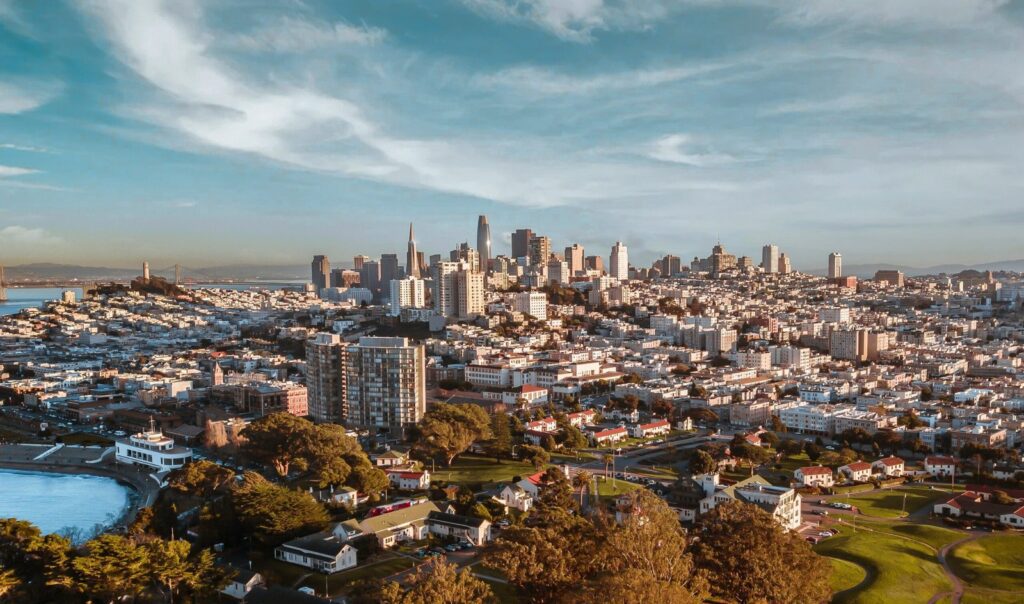
San Francisco. Electric jazz, 24-hour diners, and Mexicana coursed through the city’s veins like the pulsating neon lifeblood of the twentieth century’s best estimate of freedom. Alcatraz stands sentinel, a mirror image of the Other Coast’s optimistic monument to Liberty. The island’s incarcerated vantage point shrinks the cityscape to a postcard as if, all at once, it could be lit by a single car headlight, driven deep into the night by some imaginary Film Noir Private Eye looking for an excuse to let off steam in a bar that no longer exists. The bay water lies still, mocking the failures of the Psychedelic Era, their twelve-string guitar refrains ringing out endless echoes in the cavernous brains of the 21st-century acid casualties, which we’re told by the Travel Agents, Presidents, and Uncompromising Capitalists, wait for us on every street corner.
“The Fillmore isn’t what it used to be” / “Don’t go to The Tenderloin at night” / “Wear your backpack on your front” / “Keep a hand on your wallet and the other on your G-U-N” / “Stick to the tourist hotspots” / “Try the artisan bread at Pier 39” / “Go see the sea lions” / “Listen tothe Ocean” / “Don’t make eye contact with those weirdos on the trolleys, that’s how they get you” / “The Golden Gate Bridge has a gift shop and a café” / “There’s a Macy’s right there in Union Square… and a Rolex store” / “What’s in a margarita again? It sounds Mexican to me… Have a bourbon instead” / “SOUVENIRS SOUVENIRS SOUVENIRS!”
Subscribe to The Superhero Brief!
Free access to the CEO's newsletter.
The views expressed in this newsletter are those of the CEO and do not necessarily reflect the views of the organization.
San Francisco. It all starts here. The Summer. The Pacific. California. The Gold Rush. America and its Dream. Peace & Love. America and its Nightmare.
The Pinecrest Diner
If I’d been at home in England, walking into whatever the British equivalent of the American Diner is, hearing there was only seating at the counter would’ve been enough to spin me back out onto the street, searching for refuge in the nearest Starbucks.
But the high stools at The Pinecrest — San Francisco’s 24-hour Diner, est. 1969 — seemed to shout, “COME ON DOWN!” Their polished, heavy silver bases caught the early sun and shot it back out across the booths, illuminating families, couples, and solo patrons of all nationalities and heritages, like a melting pot mirror ball. The air was white with powdered sugar, it was black with caffeine.
At this time, in the morning in a place like this, you catch the tail end of the night-owls: the ones still running on the fumes of yesterday. You also get the early-birds as well: the cops, the tourists, the business elite — ties tucked into shirts to fend off the maple syrup deluge that’s burned them before. That’s the beauty of it — the American Diner. It’s timeless. Or, rather, it’s all times all at once. All times for all people. The Great American Cliché. But it’s only a cliché because it’s true.
No easy-listening-FM-classic-rock-radio-background-music. The Pinecrest plays the real American soundtrack: the sheer VOLUME of ongoing operation. Grill sizzle. Cutlery scrape on Formica table top. Cash register ejecting to the rhythm of fugitive coins longing to escape its drawer. All cogs working toward their highest purpose, as the servers, high on well-deserved tips, slalom the course of tables and chairs, delivering the goods and clearing the remains. Pancakes, Waffles, French Toast, and Pie. My oh my.
There’s something extremely satisfying about seeing the same thing on repeat over and over again. It has a calming effect on me. From my counter perch, shoulder to shoulder with the multi-coloured world, watching the uniformed rows of puddles settle into perfect plate-sized pancakes, I found peace. Peace without quiet. Flip, Flip, Service! Butter, Syrup. More coffee? Don’t mind if I do! I lost all sense of time as everything seemed to be happening around me. I was probably only in there an hour, but as the greased machine of unfussy fare churned like the changing seasons I could easily have lost a year. A city day in the City By The Bay. Did I mention it all starts here?
Tommy’s Mexican Restaurant
The unassuming facade of Tommy’s Mexican Restaurant — The World’s Best Tequila Bar, est.1965 — gave way to a vision of The Real American Hero. Haloed by the stained-glass lightshow of a million reflections through a thousand tequila bottles, the bartender juiced lime after lime for the long afternoon ahead. There’s something extremely satisfying about seeing the same thing on repeat over and over again. It has a calming effect on me.
With a white towel across his shoulder, he was ready to mop the myriad problems of his patrons. He tossed the ringed-out lime husks onto an ever growing pile, a daily art installation: a monument to the Margarita.
“Tommy’s Mexican Restaurant: where one arrives for a drink and leaves as a friend.”
We’ll see about that, I thought to myself.
If I’d been back home, in the British equivalent of the family-owned-and-internationally-lauded-drinking-institution, an invitation of “would you like to sit at the bar?” would have me back on the street faster than you could complain about the weather. But the complimentary platter of chips and salsa seemed to be waiting just for me, as if I was always supposed to be here, now. Take a seat, forget the outside world.
The Hero wasn’t just any bartender. He was Julio Bermejo, the actual inventor of the actual ‘Tommy’s Margarita,’ which was my favourite drink in the world. Here I was alone with him, learning about agave, cocktail ratios, optimum ice dilution, the city and its country, life and its maladies. I sampled hundreds of dollars worth of tequila — stuff I’d never get in England — without charge.
A cop walked in and joined me. He bought me a shot of mezcal, and another shot, and another shot. Bang! Bang! Bang! Someone was shot last night, right outside the Rolex store in Union Square, he said. Out here, where THEY told me not to go, it was safe. I was probably in there for about four hours, but it disappeared like a flash.
(Image courtesy of Maarten van den Heuvel via Unsplash)
Escape From Alcatraz
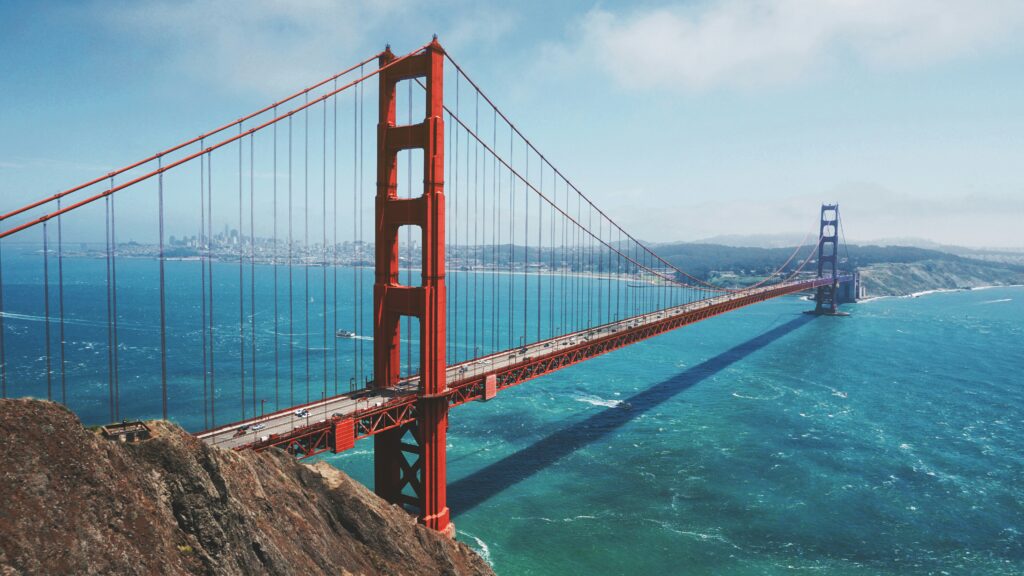
These two anecdotes are from the same day. The gap between them was bridged by walking on an actual bridge. The big red one. Its metal emerged from the hanging fog at regular intervals like futuristic robots rising from prehistoric land. There’s something extremely satisfying about seeing the same thing on repeat over and over again. It has a calming effect on me. Pausing at what I guessed was halfway, I could make out Alcatraz. Framed by the bridge, it looked imprisoned itself. Apparently, he’s thinking of re-opening it. Somewhere to put the immigrants, I suppose…
As I stood from my barstool, I understood why food and drink is a fine way to see a city: everybody gets hungry, everybody gets thirsty. The Pinecrest and Tommy’s were different in many ways. One purposely faceless and fast while the other is deliberately familiar and slow. One’s sprawling menu racing to keep pace with its clientele while the other’s expertly-measured commitment to its craft teaches us the beauty of Mexico and its delights. What unites them is this: unlike the landmarks and the tourist traps, they’re both necessary.
Both could easily sink into the commercial comfort of nostalgia, but neither does. They’re not relics. They’re relevant reminders of the value in communication & connection, meeting new people & learning their cultures, social diversity & tolerance & hope & all those other essential ingredients in the freedom we apparently seek. Both preserve the individuality of a city, a state, and a country under threat from its own leadership. They’re what San Francisco needs to be, for all of us, forever.
I said goodbye to my new friends — the celebrity and cop — and wobbled my way into Golden Gate Park. The late sun shone in splinters as the last meditative ounce of mezcal took hold. My mind was clear of all thoughts except one: a seat at the counter is always a good idea.
Jordan Frazer is a freelance writer and musician. He writes as C.P. Doosly — the Anxiety Uncle of the Millennial Generation — and is lead vocalist and guitarist of London band The Stylus Method. He is vegetarian, a yoga & meditation enthusiast, and Beatles-obsessive. He loves almond croissants and supports Newcastle United. He is married to Samantha. He is an ex-commercial litigator, qualified personal trainer, and is working on several fiction and non-fiction book projects centered around arts & culture.



Comments
Be the first to share your thoughts!
We value diverse perspectives and respectful debate.