And it is not just a hijab.
Under the Islamic regime, women are forbidden to sing.
Every Iranian woman singer you know lives in exile, not because she committed a crime, but because she wanted to sing. Even sharing a singing video on your social media as a female singer inside Iran can lead to arrest. For forty-seven years, not a single female singing voice (Iranian or non-Iranian) has been broadcast on state television or radio.
Do not ask me for the reason. As a scientist, I cannot explain what I cannot understand.
I share something in common with those women singers. I, too, have been living in exile since September 2022. My resignation was seen as a threat to the regime. My family was threatened. For my safety, I was forced not to return home.
In the past forty months, I have moved across four countries. Not by choice, but because of visa restrictions, sanctions, and the impossibility of finding stable work as an Iranian in exile.
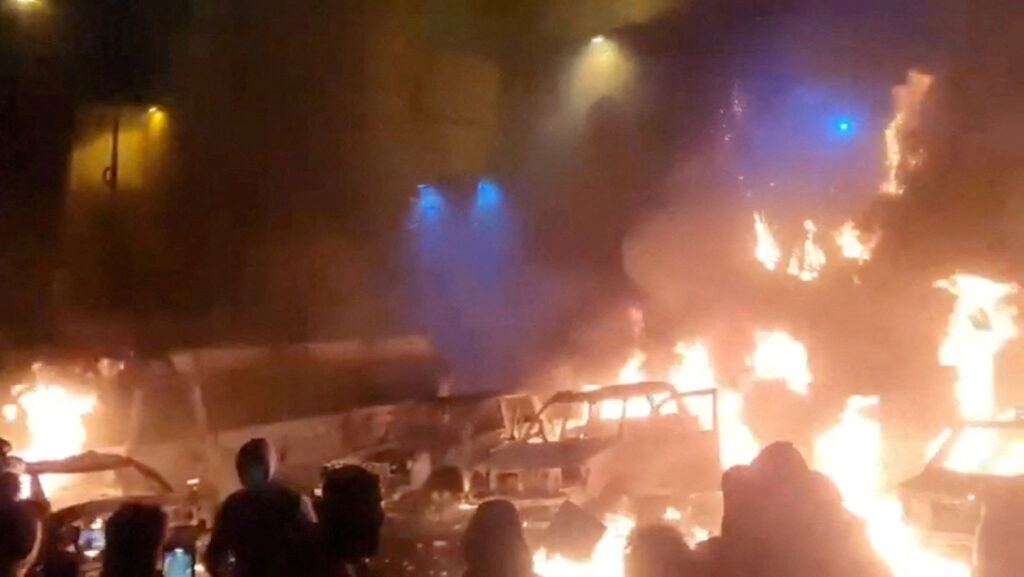
And now, once again, my country is on fire. Waves of protests have erupted across dozens of cities in Iran, with citizens demanding freedom, equality, and an end to the regime’s repressive policies. The demonstrations began on December 28, 2025, in Tehran’s Grand Bazaar, sparked by the collapse of the national currency. Although many think economic woes drive these protests, they are also about women’s rights and general freedom
And since then, my heart has lived in my throat. In 2022, even from afar, I knew how to act. Today, I do not. All I can do is write; write as someone in exile while a revolution unfolds at home.
A person who wakes up, eight and a half hours away, to videos of people being beaten and shot with live ammunition.
And who goes to sleep in tears, wondering how the arrested survived the night, how the families of the murdered are enduring their loss.
My friends in Iran and in the diaspora say, “This is the end.”
I hope it is.
But even if it is not — (and may the universe never hear this) — I am proud. Proud that Iranian women rose in 2022 and fought for their rights. No future regime will ever be able to say it granted these rights to women. Iranian women already got their rights.
Equality is one of the core demands of this uprising/movement/revolution, whatever name history gives it. We still have a long way to go. The price has been unbearably high. But we learned something irreversible: In a society where women and men are not equal, there is no freedom.
We learned to fight for our rights because, from now on, if any regime, system, law, or ideology tries to take them away, we will stand and resist.
In 1979, only a few women resisted. Many rights — such as access to education, the ability to work, freedom of travel, the ability to obtain a divorce, and political participation — had been granted from above during modernization, not won through struggle. Society was not ready. So when the Islamic regime took them away, too many accepted it since they were not even aware of them.
This time it is different.
We paid the price. And because of that, we will never forget.
So keep your eyes on Iran. What you are witnessing is a revolution against one of the most brutal religious totalitarian regimes in history. You may think I am exaggerating. You are only seeing the tip of the iceberg.
Even Iranians themselves will ask how they endured this regime for so long.
Books will be written. Films will be made. But none will truly convey the suffering, just as we can never fully feel the suffering of those who lived through World War II. That is why history repeats itself.
But one thing I know with certainty: Religion will never again rule Iran. And Islam will not be the name of the country. What is now the Islamic Republic of Iran will soon just be Iran.
I count the days until I return home, along with millions of Iranians in exile.
The Persian poet, Houshang Ebtehaj, who himself died in exile, once wrote:
میبینم
آن شکفتنِ شادی را
پروازِ بلندِ آدمیزادی را
آن جشنِ بزرگِ روزِ آزادی را
I see
the blossoming of joy,
the high flight of humanity,
the great celebration of the day of freedom.



Comments
Be the first to share your thoughts!
We value diverse perspectives and respectful debate.