Trigger Warning:Descriptions of stereotypical ideas of gender, brief mention of trans suicide rates
Clothing is just fabric.
It can be “gendered” by society or made gender neutral by individuals. It’s just textiles. I aim to exist gender-neutrally in this world, and gender-affirming clothing helps me do so. I feel a sense of euphoria whenever I put on an outfit that feels, to me, neutral. For me, gender euphoria is the sensation of feeling validated and seen in my identity. It brings me joy. But the current societal views around clothing, makeup, and bodies means I, along with other gender-neutral and trans individuals, can’t simply exist.
The history of clothing and how it changed
Before Scottish kilts, men wore early versions of skirts. I think people forget that skirts, high heels, and makeup were originally invented for men, and often had meaning in society. According to L’Officiel, “The earliest evidence of men wearing skirts dates back to ancient Egypt, circa 3000 BCE, where garments like the shendyt — a kilt-like garment made from linen — were popular among men of all social classes. This type of skirt provided both comfort and functionality in the hot Egyptian climate.”
I used to love skirts as someone who dressed in accordance with the unwritten rules for women, but this has changed since realizing that I don’t feel like I’m a woman. Skirts are not just “for women,” but are often associated with femininity and, in connection, female identity. This change that has occurred over the last few centuries means that society views anyone wearing a skirt as more feminine. For someone like me who doesn’t want to appear feminine, it’s frustrating to feel like you can’t wear a specific item of clothing.
Subscribe to The Superhero Brief!
Free access to the CEO's newsletter.
The views expressed in this newsletter are those of the CEO and do not necessarily reflect the views of the organization.
I also used to wear dresses, crop tops, and revealing outfits. But that changed after I realized my gender identity. The stereotypical “women’s” clothing is no longer what I feel comfortable in. I shop in the “men’s section” now. Clothing stores are not always easy for me to navigate due to the fact that my gender expression changes. Just because someone wears a blouse, that doesn’t mean they are a woman, it just means they prefer feminine-presenting things. It does not mean the person themselves is feminine or masculine, but that their gender expression is.
The concept of something being masculine- or feminine-leaning means that it is neutral, but leans a certain way in terms of gender expression & how it makes someone feel about themselves. Flannels are viewed as masculine-leaning by most people, while blouses are feminine-leaning.
Makeup was also seen as acceptable for men to wear throughout history prior to Queen Victoria in England and her campaign to associate it with being anti-Christian. I think makeup is genderless; it is just composed of pigment and oils. Makeup is a form of art and self-expression, and I’ve worn it since I was thirteen years old. I enjoyed playing with my mom’s makeup as a child and regularly experimented with my grandmother’s blue eyeshadow, pink blush, and red lipstick, no matter how atrocious it looked on me. Now, as an adult, I can wear a full face of makeup, but still appear gender neutral based on my outfit of the day.
The gendered history of pink
Image courtesy of the author.
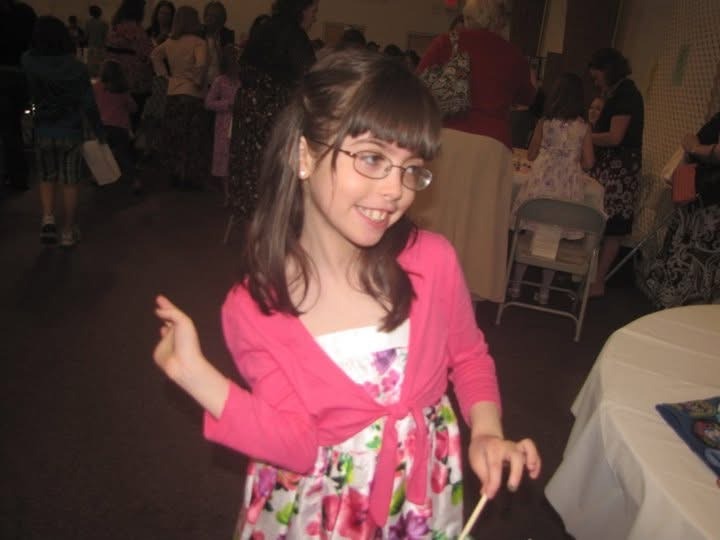
Pink was once associated with masculinity, strength, and luck. If a woman wore pink, it was to appear “manly” or to garner good luck. In the 1950s and 1960s, society shifted from thinking that blue was for “girls,” and pink was for “boys.” Society considered pink to now be feminine, and Jackie Kennedy was not the first woman to publicly wear pink, but she definitely promoted it in the 1960s. As a child, my mother often dressed me in pink because it was “feminine” and “girly.” As I grew up, I phased out of pink and replaced it with blue and purple. I didn’t care when I was younger, because it was a form of expression. Associating colors with gendered traits is harmful, because it puts people like me into boxes and assumes what they “should be” or what they “should look like.”
Facing stereotypes head-on
Gendered stereotypes are problematic, especially when traits and interests are assumed about you based on your assigned gender at birth. Just because I was assigned female at birth, that doesn’t mean I want an oven or to cook for my fiance. In fact, it is the opposite. I do not know how to cook that many dishes. My fiance does most of our cooking, because I only know how to make things in an air fryer and a few things on the stove.
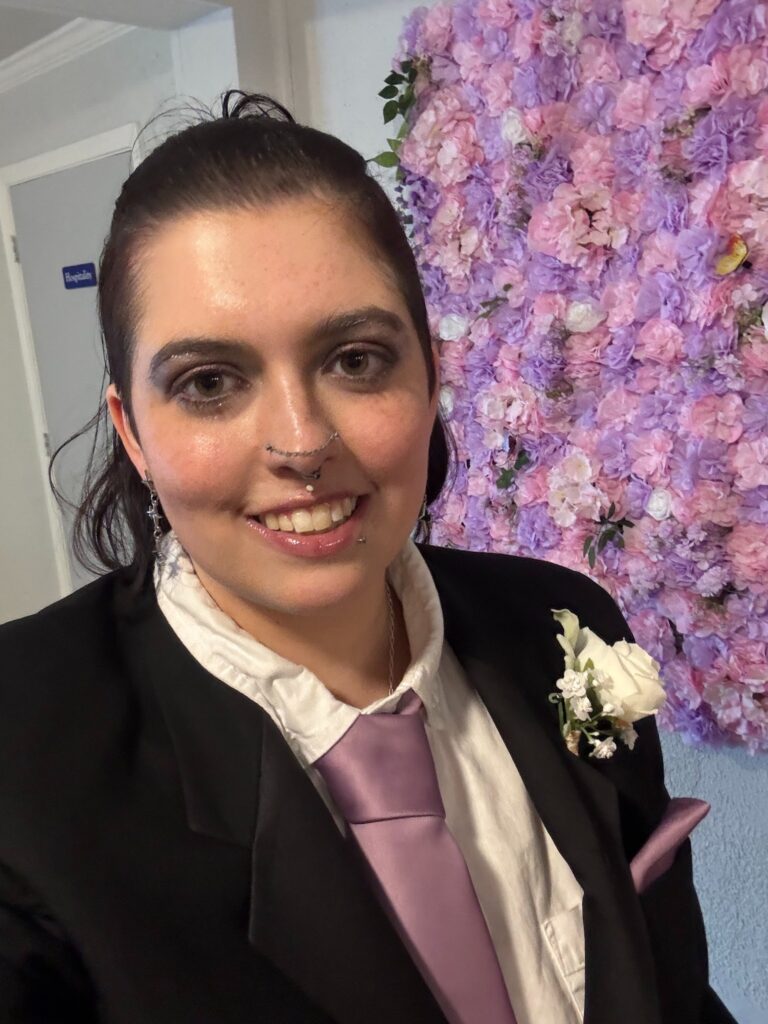
I am genderfluid and my pronouns are they/them/he, with my gender expression ranging from neutral to masculine-leaning. I enjoy basketball shorts, shirts, baseball hats, and ties. Last month, I wore a tuxedo to my best friend’s wedding.
Image courtesy of the author.
I also push through the status quo of what an AFAB (assigned female at birth) person “should be” or “should look like” whenever I put on basketball shorts or a tie.
When people assume that I am a woman based on the fact that I have breasts and wear makeup, it makes me feel dysphoric. It internally makes me feel invalidated and unseen, affecting my mental health and self-confidence. I would rather wear basketball shorts, a shirt, and a hat, instead of a dress or a skirt. Assumptions are harmful, especially when it affects how I feel about myself.
Looking forward
I hope that trans and nonbinary youth and adults will be able to live in a world where clothing is not defined by gender, and they can wear what makes them feel comfortable. I am thinking of our futures in a time where trans rights are being controlled and taken away. I wish all of us good luck and affirming thoughts as I hope that trans rights will be at the forefront of conversations about equality. We deserve happiness and well-being just like everyone else. I think we are headed in a direction where people are once again told, forcefully, what they “must” wear, how they “must” appear to be aligned with gender norms. I would like to see the direction of people being able to wear whatever they want as long as it’s appropriate and doesn’t hurt anyone. Being able to choose affirming outfits is crucial to one’s well-being and mental health. I would like to see a future where people feel gender euphoria, and where LGBTQ+ suicide rates decrease. I want to see support, trans rights being treated as human rights, and people being uplifted, not repressed or discriminated against. Give me — give us — euphoria.
Kieran McConville is a 24-year-old writer who originates from Virginia, United States. They are passionate about accessibility, inclusivity, and disability rights and their work often explores disability, neurodiversity, mental health, societal issues, and personal experiences. While primarily a poet, they also enjoy writing memoirs and short stories. Their love of writing traces back to their childhood discovery that they are distantly related to the author Charles Perrault. Kieran has a strong passion for editing, and recently earned a degree in English & Creative Writing with a minor in History.



Comments
Be the first to share your thoughts!
We value diverse perspectives and respectful debate.