As of writing this, it’s been roughly two years since I reached the summit of Mount Fuji. I could wax endlessly about the idyll of Japan, having spent 26 days exploring Honshu and Kyushu with my ex-partner, but Fuji-san was an integral milestone over and above the rest – one I shall meditate on forevermore.
Many tourists will form stark interpretations of Mount Fuji. Bask in its immeasurable beauty. Dread its perilous dangers. Truthfully, my experience was more fragmented. Fuji-san is an entity, a landmass of divinity that murmurs its own language. I connected intensely with the journey during my climb. Out of wonder? Respect? Fear? I felt my body screaming, every checkpoint marred by the knowledge of steeper ascents lying ahead, and yet I emerged with a greater spirituality I hadn’t intended to find.
Fifth station: ground zero
The bus rattled in winding meanders, past volleys of trees as the views grew increasingly more ethereal. Customary for most ascents, we were charting half the mountain by road, crossing vast, impassable forests towards an accessible basecamp. I was entranced by the cultural significance of my oncoming quest, packed into this bus full of both locals and tourists from around the globe. Since my partner had steered clear of the task, I was also totally alone.
By the time we reached the fifth station at 2,300 meters, every person was struck by the same revelation:
We were already surfing the clouds.
Subscribe to The Superhero Brief!
Free access to the CEO's newsletter.
The views expressed in this newsletter are those of the CEO and do not necessarily reflect the views of the organization.
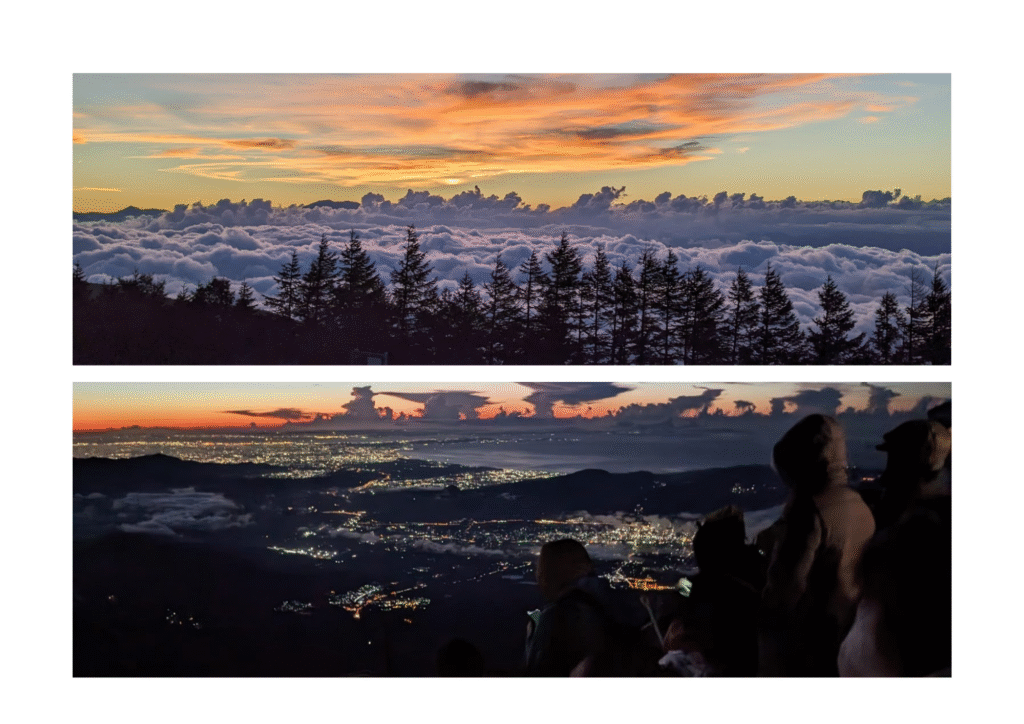
An asphalt lot spreading towards a bank of skeletal firs, and beyond that, nothing but rolling marshmallow waves tinged in gold. All I’d done was step onto a bus!
With over an hour before I was due to begin, I reviewed my inventory. Sugary food and drinks? Check. Climbing poles and torch? Check. Oxygen canisters? Check. Phone? Drastically low on battery. Not my photo ops! I was forced to commandeer a charging port on the outside rim of the visitor centre because they didn’t have them… inside for some reason…
It was during this dilemma that I met Louie, a fellow Brit. Like me, he was going alone for now and asked if I wanted some company for the ascent. Knowing I was gunning for a ‘bullet climb’ to reach the summit before sunrise, the fact that Louie told me he would be staying in one of the overnight huts further up made me wary. Eventually, we compromised, deciding to stick together until the sixth station where Louie would reunite with his tourist friend and I would press onwards.
As the sun wilted around 7 p.m., we set out on the popular Yoshida Trail, quietly confident. We’d researched the gentle and non-taxing section between fifth and sixth. Even while trekking the muddy terrain and fallen roots, we believed that darkness would be our greatest enemy and awareness our guiding light.
We lost the trail within fifteen minutes.
Somehow, we’d verged onto a tractor path, coated in loose stones and rutting indents. The angle of ascent was something like 45 degrees in comparison to the demarcated trail we’d keenly avoided some 200 meters back. Still, we pressed on. An effective shortcut, we thought.
An hour passed. Our bodies were failing. Our legs slipped every twenty paces. We had no evidence of travelling remotely in the right direction. All we knew was up.
Then a building reared into view.
Sixth station: a moment of suspension
The first milestone was wedged into an outcrop of gravel just above the tractor route. A hut offered facilities and shelter, but no functioning shops. The view was gorgeous. The distant lights of towns and villages texturing the landscape like beds of fireflies. The fading midnight colours, pockmarked by flurried drifts of cloud.
I learned from Louie about his Canadian friend, Kyohei. He was so lost, he may well have been climbing a different mountain. Several phone calls were received and dropped in this time, leaving us exasperated on the fleeting motes of phone service at this altitude. Still, Kyohei flickered between how right he believed his directions were and how wrong Fuji-san was for deceiving them.
Dutifully, I stayed with Louie for a further hour, talking through the finest details of our lives – where we studied, our passions, our hobbies, our fears. When Kyohei finally found us and I bade the two of them farewell, the appreciation for life’s individual complexity and the beauty of human collision stayed on with me.
The route to seventh was smooth and repetitively serpentine. Shockingly, I found the temperature so mild that I stripped down to a t-shirt. Despite the purported frigid conditions at this altitude, I didn’t apply any more layers until the summit.
What was glaring during one of my breaks was the utter silence in my vicinity. No additional climbers were visible behind or ahead of me. No wildlife, no traffic, no environmental disturbances. This was a vacuum, devoid of sense. Time had been suspended. There was something spiritual about this immersion in the faraway, this stretch away from noise. Something healing.
Seventh station: sheer insignificance
I’m confident about my fitness. I run regularly and stay active through work. I’ve climbed hills with challenging conditions before.
Oh boy, this was beyond that.
Following seventh, the angle of elevation hiked steeply. Surfaces underfoot became ever more perilous – I’m talking avenues of boulders, sharp chicanes overlooking fatal drop-offs, steps that felt like ladders. The threat of danger was suddenly unrelenting.
With some near misses under my belt, I started to comprehend how insignificant my existence truly is. I’m eleven stone (give or take) of carbon, bones and messy opinions. With one misstep, I could have been reduced to a smear along the countryside.
For any intending to make this climb, please prepare for the worst (that includes renting all the necessary equipment, including poles, torches and gloves – survival is unlikely without these) and please don’t underestimate the difficulty from guides you may read online.
And, you know, don’t get lost on any unchartered tractor paths.
Eighth station: hunger and resilience
By eighth, there were signs of civilization. Most of the overnight huts were located nearby. Suddenly apparent was the hunger lurking in the pits of my stomach and a severe lack of snacks remaining in my backpacks. My breaks were growing longer, whilst my contemporaries seemed to be coping just fine. Damn these unbothered gurus of mountaineering…
I needed help, and having relied on my partner (who had been studying for a year in Japan) for the majority of our communication, I felt lost locating it. I considered throwing in the towel or renting a hut for the night, but in the end, I sucked it up. Somehow, I managed to acquire some chocolate after a bungled back-and-forth with some retailers, which was a small moment of pride for me. I could do this on my own.
There was one universal language up here – resilience. Every soul was laser-focused on the same triumph and I knew this determination would translate into movement. I knew we would prevail.
Ninth station: the shove
Just before ninth, the Yoshida and Subashiri trails intersected. Suddenly, where before isolation left you exposed, you could barely move through queues of bodies shoving impatiently towards the peak. Somehow, it felt further away than ever.
In many ways, this was the easiest part, and the most encouraging. Forced to shuffle at a snail’s pace, you can catch your breath more easily. Plus, you finally appreciate the sheer volume of cultures surrounding you. Climbers young and old, timid and bold… every race, religion and creed, every unique background and occupation, all united, breathing down each other’s necks and longing for the rocks to level out underfoot.
My thoughts drifted to Louie and Kyohei. I wondered if they’d made it to their hut, or whether they’d made the final push. I only hoped they hadn’t turned back too soon.
The summit
There was something initially underwhelming about reaching the summit. There was no great final obstacle, no fanfare. The upward push simply ended, filtering into a condensed community of buildings where I was finally able to get a warm udon meal (transformative) and rest, dwelling in the majesty of what was to come.
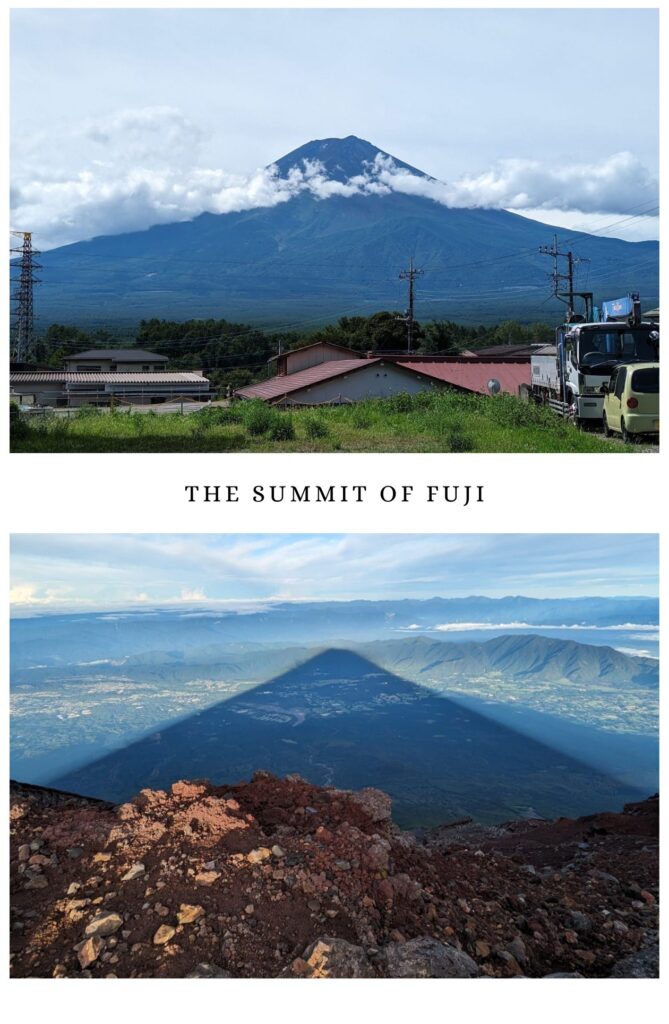
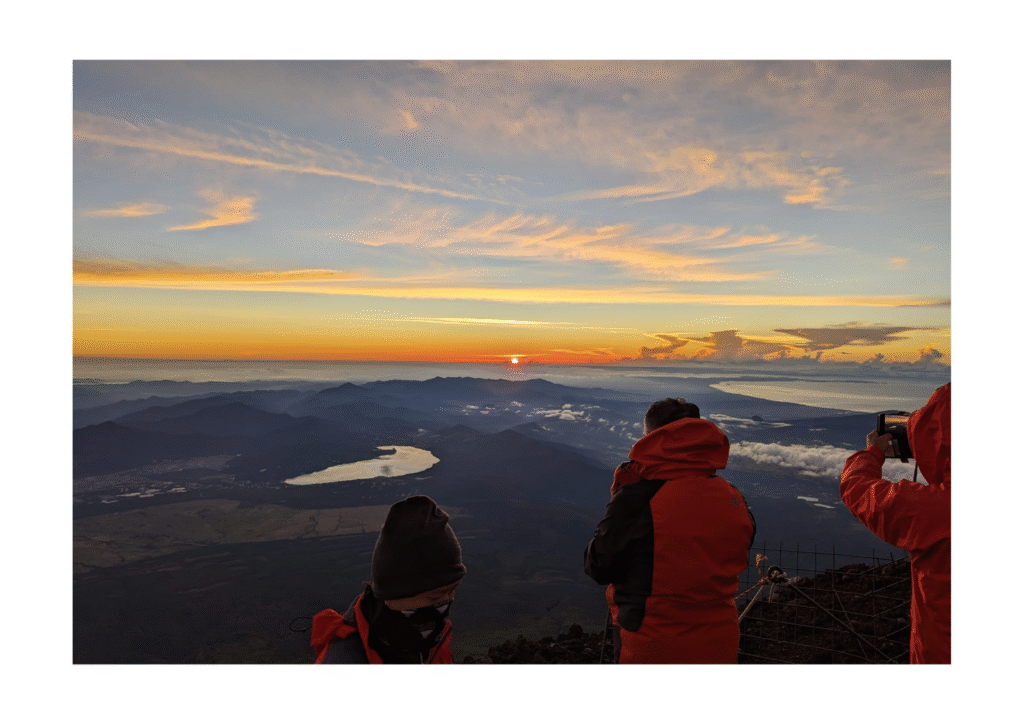
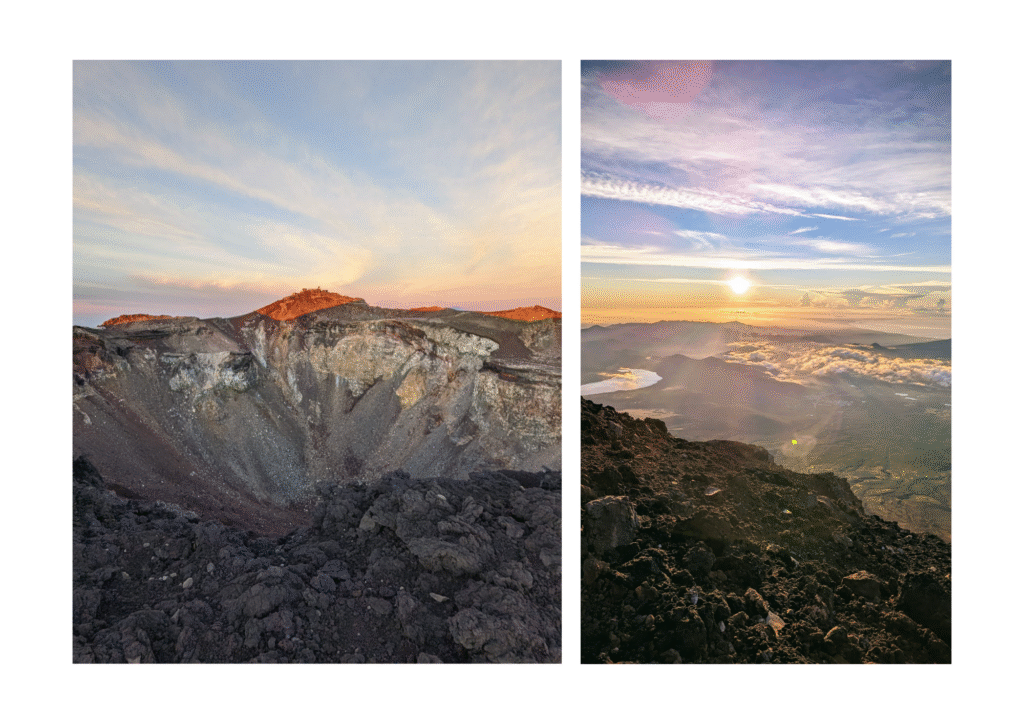
Everyone gathered along a rocky hill encircled by barriers. This appeared to be a designated lookout point, facing the eastern sky. And at 5 a.m., far from our vantage at the top of the world, a beam broke free from its twilight.
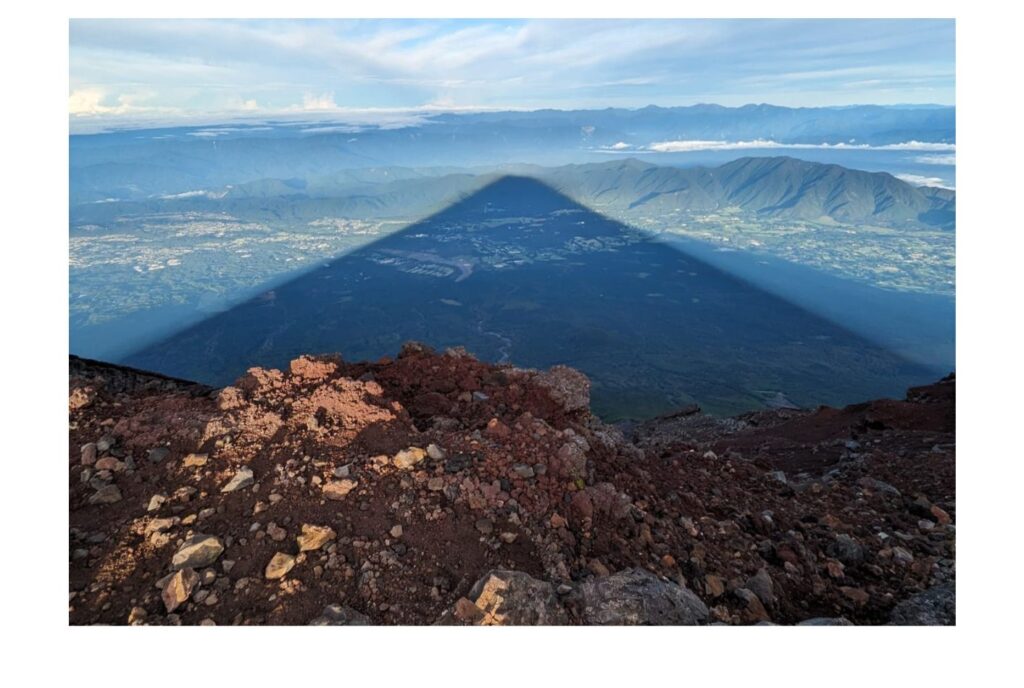
1,476 meters. Nine and a half hours. One of the most extraordinary feats I’d accomplished. With my newfound triumph and a warm meal in my belly, I felt more awake than ever. I took an extra hour or so (as many climbers do) to walk around Fuji’s caldera, one part of which descends into the crater. They just let you do that. You can climb into an active stratovolcano. It’s crazy.
The future of Fuji
Many elements have changed since I ascended the mountain in 2023. For one, it now costs 4,000 yen per person to climb, whereas before donations were voluntary. The trailheads are now closed off in the evenings between certain hours to any climbers not staying in huts. That aside, I found this experience to be utterly life-changing and would recommend it to anyone daring enough. I would do it again in a heartbeat.
Jake, very tall, holds a Master’s degree in scriptwriting from Goldsmiths: University of London. Born and raised in Northamptonshire, Jake creates work that spans stage, screen, and radio. He is invested in examining magical realism, particularly the mystical nature of childhood wonder and the innate personality of inanimate objects. Outside of writing, Jake is a keen parkrunner and improv comedian, two activities that greatly benefit from his remarkably elongated limbs.



Comments
Be the first to share your thoughts!
We value diverse perspectives and respectful debate.